Apnea Nurse: You do snore quite a bit, so…
Jacob: Literally–
Apnea Nurse: The snoring will go away. You can tell your wife that.
Lately, my wife has been complaining that I am snoring. So, I went to an ENT. And they sent me to a sleep specialist.
Apnea Nurse: Sleep apnea is diagnosed when you have a repetitive cycle of where you stop breathing for 10 seconds. Mild sleep apnea is five to 15 pauses per hour. Moderate is 15 to 30. Severe is considered anything over 30 per hour. When you did your study, Dr. Patel was able to see 17 pauses per hour–
Jacob: Okay…
Apnea Nurse: Which classified you as having moderate sleep apnea because you fell between 15 to 30.
[MUSIC ENTERS]
Apnea is a disorder where your breathing rapidly stops and starts while you sleep. Symptoms of sleep apnea include loud snoring, gasping or choking awake, fragmented sleep, and crushing daytime fatigue.
And there’s two kinds: Central sleep apnea is when your brain forgets to remind you to breathe. Obstructive sleep apnea, the kind I was being diagnosed with, is when your airway is blocked. In my case, I had gained enough excess weight that something I didn’t even know was possible had happened: My throat had gotten fat. And it was causing me to stop breathing in the middle of the night.
This is what doctors call fat sleep apnea.
[MUSIC ENDS]
[POWER DOWN SFX]
Apnea Nurse: Well, um, we don’t say that.
[MUSIC RETURNS]
Okay, fine. So doctors don’t really call it fat sleep apnea. They say it’s caused by an obstruction. But just to be clear, in my case, the obstruction was my fat throat.
Apnea Nurse: Number one cause for sleep apnea is weight.
I’m five eight and I’m kind of stocky. For me, a comfortable weight is around 190. At this doctor’s appointment, they weighed me in at 238 pounds.
Over the last few years, I’ve been tired all the time. I never felt rested. I assumed a lot of it was from having a new baby, but as that new baby grew into a toddler who slept through the night, I couldn’t really blame it on him anymore. And because I was tired all the time, I wasn’t as active, and because I wasn’t as active, I started eating shittier and it… it was a vicious cycle.
[MUSIC ENDS]
Anytime I go to the doctor, I’m just hoping for a definite answer, and I never get one. But here I was getting a definitive answer from a doctor on not only what was causing it, but how to fix it.
Apnea Nurse: Minimum, you should be losing about 40 pounds. Then if you can get to 200, it will reverse. If you never lose the weight. Sleep apnea never goes away.
This was clear as they come. If I lost enough weight, my apnea would go away. But talking about losing weight is easy. Actually losing it is hard. Over the last few years, I’d tried eating better, counting calories, going for walks, intermittent fasting. I even did hypnotherapy. But there was one thing I hadn’t tried.
[PHONE RING]
Jacob: Hey, is this Dr. Reed?
Trainer Jacob: This is he.
[THEME MUSIC]
Today on the show, I hire Jacob Reed to help me get rid of my fat throat.
TEASER CLIP MONTAGE
[PHONE RING]
- “Are you aware of the guy that did the Twinkie diet?”
- “Dual x-ray technology fat tissue and your bone marrow density…”
- “From very low to superior, I am as low as you could be.”
- “I do blame you.”
- “There has to be friction. There has to be a struggle.”
- “Your belly button’s a poo poo hole.”
- “This is insane.”
- “One is like a brain swelling thing”
- “I don’t want this to be how my body works.”
SHOW OPEN: Welcome to Jacob Reed and me / and me / Jacob Reed and me / Jacob Reed and me / and me / and me / a docuseries / a mystery show / a rabbit hole / a mundane multiverse / an investigative comedy / that answers life’s biggest questions / life’s biggest questions / exclusively by tracking down people / tracking down people / named Jacob Reed / Jacob Reed / Jacob Reed / Jacob Reed / hosted by me: Jacob Reed.
Today on the show, Jacob Reed Number 68: The Heavyweight.
I have a lot of issues with my body. I think it’s worth saying this is the episode of this podcast is the one I never wanted to make. I tried to quit making it so many times because I am deeply embarrassed by not only having these body issues, but having the body that causes the issues in the first place.
I’m the product of a culture that’s equally obsessed with body-shaming AND with get-fit-quick schemes to address that shame. It’s pervasive, but when I was growing up, it sounded like this:
- Weightwatchers keeps out the extra calories
- Ultra Slim Fast
- Suzanne Sommers: Thigh Master
- Chuck Norris: I use the total gym
- Snackwells
- I decided to call Jenny Craig
- Lose that weight, get your body slim. Lose yourself in the taste. It’s Dynatrim!
There was even a product called…
NEWS CLIP: Olestra, an edible but indigestible oil. [TV static] Frito-Lay rolled out a line of potato chips fried in Olestra called WOW!
My family eagerly bought those new “Wow” potato chips made with Olestra. And I vividly remember an urgent trip to my parents’ downstairs bathroom… because the indigestible oil caused explosive diarrhea. On the package, the Frito-Lay corporation euphemistically referred to this as “anal leakage.” If you’re too young to remember, this is a real thing that happened.
CSPI Spokesperson: It’s only a matter of time before products containing Olestra cause deaths.
And for a few years, Americans decided it was less embarrassing to diarrhea yourself to death than to stay alive and be fat. But decades later, the diet fad that Americans spent half a billion dollars on… only remains as a joke on Family Guy.
Peter Griffin: Bring back Lays WOW chips with Olestra.
Woman: Mr. Griffin, those chips were recalled in the nineties for causing explosive diarrhea.
Peter Griffin: You heard me.
Despite being excited about the Olestra chips, I was a pretty active kid.
I was active throughout high school. I did martial arts. I played lacrosse. I played ultimate frisbee and baseball with friends. During the summers, I worked all day at an aquatics camp on the bay in San Diego. I swam, sailed, kayaked, wakeboarded, windsurfed, and played with the kids at the camp all day. There’s a picture of me being thrown into the water by a horde of seven-year-olds, and I have a six-pack. To be fair, the six-pack is mostly because I’m being stretched out as I’m being thrown into water, but I was in pretty good shape. And even then, I felt like I was too fat.
In college, I went on medication for anxiety and depression, and one of the side effects was weight gain, but also, I was away from home for the first time, and I had access to foods my parents would never stock in our pantry at home. Was suddenly more sedentary, stayed up too late, had hangouts full of late night diners, hitting up taco trucks after parties
When I graduated from college and was doing comedy, I got a commercial agent.
[WAITING ROOM AMBIENCE]
Every once in a while they’d send me out for an audition, and I wouldn’t realize until I walked in the room and saw a bunch of guys much heavier than me… that it was a fat guy part. One time, the next thinnest guy – who probably had 80 pounds on me— looked at me and said “Oof, sorry bro. Guess you’re with us.” Eventually the agent told me that — in Hollywood terms — I was too distractingly overweight to play ‘normal guy’ but not cartoonishly fat enough to play ‘funny fat guy.’
[Family guy clip: You heard me]
I got in good shape for our wedding, probably the best shape I’d been in since high school. But by the time we had our first kid, I didn’t want to hang up our maternity photos because I was embarrassed by how much weight I’d gained. And this was standing next to a pregnant woman.
Point being: while my weight has fluctuated, my issues with it have not.
The doctor who referred me to the sleep apnea clinic even suggested a GLP1 and that they personally had success with that method of weight loss. I’ll skip through a few hours of me calling around to get a consultation, etc. and just say that while my issues with my body have been persistent, I really do feel like the last decade of life choices got me to where I am, and It was important to me to explore reversing some of those choices on my own.
And so… I called up trainer Jacob Reed.
Jacob: Hey, my name’s Jacob, and I’m hoping to set up… I guess a consultation.
Trainer Jacob: Uh
Jacob: Is that- do I have the wrong–
Trainer Jacob: That’s an interesting question.
If Jacob sounds skeptical, one reason is because the number I found for him online is actually his private cell phone. But the other reason is that Jacob was already in the middle of a same name mystery of his own.
Trainer Jacob: So I am a coach. The reason I sound skeptical is there’s Jacob [BLEEP], he’s higher up in the company. And so I think people have been sending emails to me, which I think they’re intending to go to him.
Trainer Jacob: And so when you said that, I was like, is this real or not? And so, are you looking for coaching, or what are you looking for?
Jacob: So I’m looking for coaching. I’ve probably gained about 40 or 50 over the last five years. [kids noise] Um, you’ve got kids in the background. I also have kids.
Jacob: I keep trying to put the weight gain on them, but um, I think it’s on me. [laughs]
I gave Jacob some more context about my fitness journey, but then I realized I was getting ahead of myself.
Jacob: There’s a twist to this, you were saying that there’s, uh, another Jacob that gets confused with you. So the way I actually found you initially is that uh, I’m Jacob Reed also.
Trainer Jacob: Oh, really? [laughs] That’s awesome.
Jacob wasn’t currently taking on new clients. But, he was so tickled by us having the same name, he made an exception.
Trainer Jacob: You know what? So I am showing up as booked on the website, and so the fact that you reached out is absolutely awesome. The fact that I know you’ve got kids, I understand. I am really, really happy to work with you. Um, 100%.
Jacob and I made a plan to do a longer call a few days later.
I knew he was a personal trainer, but what I didn’t know is he’s not just some guy at the gym…
His training was extensive.
[MUSIC ENTERS]
Trainer Jacob: I’ve done Olympic weightlifting. Football in high school, rugby in high school, rugby in college… I don’t know how many half marathons, uh, five Ks, 10 Ks, that kinda stuff. The first marathon I ever did was just self-supported on the back roads in Iowa.
[MUSIC OUT]
In case you missed that, dude just said he ran a marathon by himself. It wasn’t an official thing. There weren’t numbers or medals or even any other people.
Trainer Jacob: I had to wear ski goggles so my eyes didn’t freeze over. It was insane.
On top of all that, he’s also authored or co-authored 17 scientific papers about physical education.
[MUSIC IN]
Trainer Jacob: I teach exercise science and strength conditioning classes. I have my PhD in support physiology and performance, from East Tennessee State University, my master’s from University of Memphis, and my undergrad from University of Northern Iowa.
Trainer Jacob: And then my wife —who has two master’s degrees, one in special ed and one in early childhood education—is just like, “This is normal.”
[MUSIC OUT]
Jacob: How many degrees do you and your wife have between you?
Trainer Jacob: She has three. I have three, so six.
Jacob: So, six degrees.
Jacob: You’re smart.
Trainer Jacob: I know what I know in this field, but I’m also very well aware of what I don’t know.
Jacob related to my experience of heading toward 40 and realizing I wasn’t treating my body the way I should be.
[MUSIC ENTERS]
Trainer Jacob: In February of 2021, I decided there’s some aspects of my life that I needed to address. My own personal relationship with food as well as getting back into enjoying lifting weights again. And just, like stress management.
Trainer Jacob: ‘Cause I have three kids, they’re effectively six, four and two. And I knew that if I were to address those things, it would be a net positive.
To give some direction to his goals, Jacob decided to compete in a bodybuilding show when he turned 40.
Trainer Jacob: I wanted to really work intentionally at addressing those components of my life. I’m four years away from it right now.
MUSIC OUT
Jacob: Did having kids change how you thought about food?
Trainer Jacob: Absolutely. I at least had enough awareness just based on my education. An approach that’s like I don’t care completely anyway what you guys eat. If you want to have Oreos, they’re not on the menu right now.
Trainer Jacob: Let’s have some dinner and then when we’re hanging out later tonight, absolutely, let’s eat some Oreos.
Trainer Jacob: They eat three and they’re like, all right, I’m full.
Trainer Jacob: The cause of a lot of our health issues is just the quantity of food that we eat. The quality of the food absolutely has an impact, but I think it is vastly overstated.
I really liked Jacob’s common-sense approach to talking about food. It was really impressive, and the fact that we were both navigating how to talk about food with our kids made me feel like we had a lot in common. I asked him how he usually works with people.
Trainer Jacob: I do video recordings for clients. They’ll send it to me with their stuff, and then I’ll watch it and then I’ll record a video back, send it to them. And more often than not, like the conversation is taken care of.
Trainer Jacob: The check-in is weight, body weight. So at least three weigh-ins a week, uh, will help me make sure that everything is on point.
Jacob’s approach focused on the basics.
Trainer Jacob: I’m not a fan of the term diet.
Trainer Jacob: The reality is that, when comes to losing weight, you have to be in a calorie deficit.
Trainer Jacob: Are you aware of the guy that did the Twinkie diet?
Jacob: I’m not aware of that guy.
Trainer Jacob: He ate only Twinkies for all of his calories…
Jacob: Disgusting.
Trainer Jacob: yeah. And I think he also had like a can of vegetables a day and he ended up losing an obscene amount of weight, and his, all of his blood profiles improved.
Jacob: What?
Trainer Jacob: ‘Cause he was in a caloric deficit.
Trainer Jacob: So like his age, his cholesterol, um, fat in his blood, that kind of stuff.
Trainer Jacob: Is that the good a way to go about life? No, but that also wasn’t point that he was making. The point that he was making was that like, look, just be in a deficit.
Trainer Jacob: Consuming whole foods that are plant-based with lean protein sources, that is absolutely wonderful. But food is meant to be enjoyed. If you wanna Have the foods that you enjoy, enjoy them, but let’s also learn to consume those things in moderation with foods that are going to help support our goal.
Jacob’s take was that I could lose weight and enjoy the food I was eating. He even said that indulging purposefully and occasionally could have its place.
Trainer Jacob: Or it’s like, Hey look, it was, the Super Bowl. I went out and had some food and like, yeah, I’m super happy you had a good time. Even if you’re off point a little bit, that’s no worries. Just keep moving on because dwelling in the past does nothing for anybody.
And Jacob’s approach to exercise was similarly pragmatic.
Trainer Jacob: As long as you’re training hard enough and that you enjoy it, it’s a really effective way to go about training.
Trainer Jacob: A lot of people, I think, believe that they gotta just crush themselves on a daily basis. That’s not sustainable. It should be fun.
[MUSIC ENTERS]
Everything Jacob was saying resonated with me. So we agreed to start working together.
After the break, I start my training with Jacob Reed.
[MUSIC STOPS]
BREAK
Trainer Jacob Reed, PhD, had agreed to help me lose weight. But before I got started, it occurred to me that every good fitness story needs a before and after image.
[MUSIC ENTERS]
Since this is a podcast, we had to find something that gave us data in a format that would translate to audio.
And honestly, I looked into hiring the people who do audio descriptions for TV shows to describe my body, but that felt humiliating.
Instead, I found a lab that would hook me up to a bunch of equipment and put my body on a giant platform it could scan like airport luggage. Much less humiliating.
Dani: So you have, dual X-ray technology analyzing all of your tissue, it’s gonna be your fat tissue and your bone mineral density.
I’m at a place called Dexa Body, which is a fitness testing and diagnostic center. Dani, their technician, is scanning me on a giant platform called a DEXA Scanner.
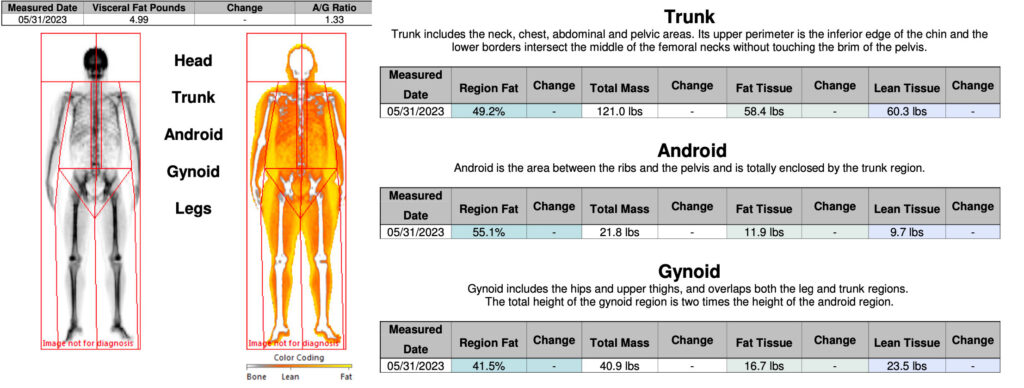
A DEXA scan is an x-ray test that measures bone density and body composition, providing a scan of your entire body, and both the quantity and location of fat, muscle, and bone mass.
Dani: Once you break down that the weight, it’s not mostly fat, it can be very eye-opening.
I came to Dexa Body for the DEXA scan, but they also offered VO2 max and resting metabolic testing to determine my overall physical fitness.
[MUSIC ENTERS]
Imagine the training montage in a movie where some indoor kid scientist has to go to space, so they check their physical fitness, but instead it’s me…
[MUSIC OUT]
…with my dad bod hooked up to a treadmill with a bunch of wires on my chest and arms, and a gas mask-sized air monitor over my face that has a tube coming out of it.
[MUSIC IN]
Dani: So please hold this on top of your nose and your mouth.
Jacob:Mm-hmm.
Dani:Thank you. And we’re gonna open this up and adjust these velcros, so it’s…
Jacob: Oh my god.
Dani: It’s gonna be in strenuous exercise.
Dani: So if you do feel unsafe, you feel like you’re, you’re going puke. Yeah. I’ll please lemme know.
Jacob: I’ll let, I’ll let you know.
Dani: The first speed is gonna be two miles per hour, and we’re starting now.
Dani: Very nice work climbing up steady.
Dani: Increasing again in 10 seconds.
Dani: We’ve already reached your anaerobic threshold from this point forward. Keep pushing for as long as you can, but I’ll be switching just one variable at a time.
Dani: All right. Alright, very good. So we’re gonna bring the speed down and the incline down. Stop from your peak there. Alright. Whenever you feel safe, please come back into a treadmill and walk without assistance. Let your heart rate come down. This is recovery time. I’m gonna print this out for you, so let’s ready when you’re ready.
After I finished about an hour of scientific testing, Dani sat down with me to review the data.
Dani: It’s just a matter of having the right data so that you can approach your goal with an informed decision.
Jacob: Just seeing all the fat in your body,
Dani: The, the imaging–
Jacob: Smushed up and then, and then draped over a normal sized skeleton is, uh, sobering.
It’s hard to explain the image of this thing with my voiceover. So, here’s some tape we got later when I showed it to my wife, Heather, and my friend Barry.
Heather: You have a wide rib cage.
Barry: This is insane.
Heather: Also, like your neck.
Barry: I think you’re just really thick.
Jacob: I am thick, but I’m also fat.
Yeah, I’m kind of regretting not just hiring the audio description people, and I have to say it, the way the DEXA body broke down the science behind what was going on in my body without judgment or baggage was really helpful. It was just facts, numbers I could dial up and down. However, once we got into those specific numbers, it did bring me back to reality.
Dani: So right now, It’s really up to you how much you want to go over your report.
Jacob: Okay, so lemme just read over it. 43% total body fat.
Jacob: It says, my total mass is 237.8,
Jacob: Fat tissue is 99.1 pounds, wow, that’s a lot.
No matter how you slice it, hearing that I had 99 extra pounds of fat on me was discouraging. To give you an idea of how much fat that is, one of my favorite things to eat is a pint of Ben and Jerry’s ice cream. And, if you’ve ever heard the phrase, a pint’s a pound, the whole world round… that must have been before shrink-flation because currently a pint of Ben and Jerry’s ice cream only weighs 0.87 pounds.
That means, me having an extra 99 pounds of fat on me is like carrying 113 pints of Ben and Jerry’s on my body at all times.
Looking at this report, it seemed like their clients were normally, ehh, not like me.
And even the image of a human body on the report seemed to be mocking me.
Jacob: At the top, there’s a picture of a guy taking the test. He i s not wearing a shirt.
Dani: Yeah. We don’t get to choose the template for this, unfortunately.
Jacob: Yeah. He’s jacked. Then at the bottom it has a thing where it says fitness level. Very low, low, fair, good, excellent, superior.
Jacob: And I am noticing that very low is highlighted.
Dani: Yes. Those are your results.
Jacob: Okay. Wow. From very low to superior. I’m as low as you could be.
Dani: Yes.
Jacob: Okay. But that’s good. The bar is set low.
Dani: You can only improve.
What I thought would be an image to showcase my future success turned out to be an incredibly humbling first step.
In the past, I’ve been lucky enough to work with some friends who are personal trainers, but working with Jacob was a completely different experience than anything I’d done before.
[MUSIC ENTERS]
Jacob’s process involved sending video updates. I would make a video telling him what I was doing, what I was eating, how physical I was being, and he would respond almost immediately with motivation and positivity.
Jacob: I was hanging out with my brother and I was like, what kind of dessert do mom and dad have? Like,
Jacob: They have ice cream.
Jacob: And my brother was like, I’m gonna have some mint tea. Do you want some? And I was like, sure. I had mint tea and I was like, fine. I kind of wish I could get into that feeling a little bit more.
Trainer JR: A lot of times people will mistake thirst for feelings of hunger. Tea is absolutely wonderful. Anything along those lines can be incredibly powerful tools for reducing calories.
He was literally a fitness professor, so he had so much knowledge and the way he broke things down was simple and helpful.
Trainer JR: Hey, Jacob. As promised, I have, uh, sent you your planning, uh, for nutrition and training.
Trainer JR: One tablespoon of say an oil or cheese. It’s effectively the size of a thumb.
With each video I relayed all the details of my daily diet and meal prep.
Jacob: for lunch, I had two small, flour tortillas with two ounces of, great white northern beans or whatever they’re called on each of them, and about an ounce on, uh, of cheese on each.
And he started to point out patterns I had never realized before.
Trainer JR: Whenever you snack, or at least the majority of snacking is sweets. When you have when you have that urge to snack, that’s readily accessible that falls into that vegetable, even fruit category
And, Jacob kept guiding me gently in the right direction. But, I felt like all these small changes weren’t getting me where I wanted to be soon enough. I wanted big changes.
Jacob: So I know you’re trying to get me to be consistent with the exercise, be consistent with the eating. but is there any point where I amp it up? Like, is this it?
Trainer JR: So… Is this it? Do we ramp it up at all? We want to make sure that the consistency is there, that you are being mindful with your, dietary choices, your lifestyle choices, and the small changes that we’ve made here are now a normal part of your life.
Trainer JR: Once they feel like they’re a normal part of your life, 100%. We can absolutely start ramping things up.
Jacob: I go back and forth between like, I believe in the process and why isn’t anything changing, and then I just wanna like bail.
Trainer JR: I 100% understand your frustrations with where your body weight is right now.
Trainer JR: So when people go through substantial weight loss, , journeys, more often than not people end up gaining back the weight they lost and then some.
Trainer JR: I prefer to have people focus on the behaviors, having positive relationships with food, and making decisions that are conducive to their overall health and well being both physiological and psychological.
Trainer JR: Appreciate that it will occur and have a mindful sense of action that everything you do is resulting in progression toward your current goal that will also set you up for long term success.
[MUSIC IN]
Jacob: Hey Jacob, just checking in. It is… March 22nd // March 24th // April 4th // April 5th // April 10th, April 13th, 14th of April, April 17th, 26th… (fade out)
[MONTAGE OF DATES]
Soon I was starting to see the patterns myself. I was eating a lot of carbs and not a lot of protein. So, my choices started to change.
Jacob: We made tacos last night. My wife got some shredded jackfruit. That’s a vegetarian substitute for, um, shredded pork.
Jacob: A serving of that has two grams of protein. We also had beans with the tacos and the serving of the beans had eight grams of protein. And so I was just like, the fuck am I doing with this jackfruit? You might as well just go with the beans.
Trainer JR: The biggest thing that I look for is what kind of protein is in them. Cause a lot of times, the vegan vegetarian options, they use a low-quality protein. It’s just not as good.
Real quick I wanna go back to the jackfruit thing. First, as someone who eats mostly vegetarian — this was an enormous revelation. I learned that most veggie substitutes are marketed for having a similar texture or photographic resemblance to meat… but not for their actual nutritional value.
But, I also want to go back to it because of the language. I’ve learned through making this podcast that I have a potty mouth.
Jacob: The fuck am I doing with this jackfruit?
And nowhere has that been more apparent than the ten hours of tape back and forth between me and trainer jacob.
It became clear just how emotional I am about food and body issues.
Jacob: Fuck, I’m really gonna have to figure out how to eat more chicken and fish // Whatever the fuck is in a peppa pig bar // who the fuck knows if it would even be accurate // I ate so much fucking pizza // so fucking high in sugar // it was so fucking good // so fucking hungry // fuck, I’m hungry // fuck I need energy to mainline cafiene and sugar // I eat bullshit // eat whatever the fuck I want // and someone’s grandma cooked and it was fucking awesome // feel like shit the next morning // fuckin’ grapes are delicious // if I don’t just eat shit // they have like a shit ton of protein // holy shit that has that many calories // I gotta get my shit together // i fucking love cheese // how fucking sick water is // bullshit snacks or sweets // let’s fucking go // bullshit snacks bullshit snacks // I get so fucking sweaty // then I was like fuck it I’ll log it // ah fuck I’m eating like shit I shouldn’t record it…
At first, I thought this form of checking in with videos would make things less direct, but we actually learned a lot about each other and the things we had in common. We talked about parenting.
Trainer JR: We just got a switch for Christmas this year. I thought that that would be fun to be able to have that kind of connection and share it.
Migraines…
Trainer JR: I actually had debilitating migraines when I was in middle school. For me, they were stress related.
Our creative process…
Trainer JR: I was on some dirt roads…our minivan had this nice coat of beautiful red dirt And before I took it to the car wash I took a little plastic spoon and I was scooping the dirt into the paint cup holders because I want to take the dirt and mix it with like a white acrylic and paint a sunset. I thought it was cool to just save the dirt as a, as a pigment for, for painting.
No detail escaped Jacob’s perception.
Trainer JR: Super random, but I noticed you were in a timber frame house. My dad has been a timber framer his entire life.
Trainer JR: It was just cool to see you in that kind of environment just ’cause it’s, I don’t know, it means a lot to me.
We even named our companies with the same pun.
Trainer JR: I saw your all trades tagline. My company’s name is All Trades Fitness. I’ve always considered myself jack of all trades master of none but better than a master of one.
It all had a very personal touch. Honestly, it was kind of like having a pen pal.
Trainer JR: Funny enough, my birthday’s actually on Friday this week.So even same name, same month birthdays.
Jacob was providing support that went above and beyond. I felt like he was prioritizing me and taking good care of me. It felt like I was getting the best possible advice from a professional. And this was a real chance to lose weight. Which is why it was so disappointing when everything fell apart.
More on that after the break.
(BREAK)
The first few months I worked with Jacob went great.
I was motivated.
Every time I felt bad about my progress, he encouraged me.
But as time went by, I started slipping.
Jacob: Hey. It’s Friday. Um, I have not wanted to do this all week and I can’t really tell what is going on. So, I didn’t do a weigh in on Wednesday.
Jacob: I feel like subconsciously I’m like bailing on this and, um, I don’t wanna be.
Trainer JR: Hey, Jacob, man, you’re not trying to bail at all. You are a human being. This happens to everybody. It happened to me and what really helped me was having a coach. It’s a sense of accountability.
Trainer JR: You’ve got your goals. Let’s just keep on working through ’em. Whatever happens, has happened. Like, there’s nothing we can do about the past.
Trainer JR: You’re crushing it. You absolutely are. Everybody gets down about the process. It’s a good coach’s job to bring you back up and to let you know that I am here for ya.
Sometimes I’d feel guilty about missing a check-in, so I’d want the next communication to have really good news in it. and if there wasn’t any, I would kind of wait longer until there was some.
[MUSIC ENTERS]
Jacob: Later that day after I made that video for you, I went for a walk around the lake with my kids, pushed ’em around the stroller. That was great. The next day I took them both to the zoo by myself. There’s this thing at the San Diego Zoo The Skyfari, and it’s like a gondola that goes across the whole zoo up in the air. And our stroller was slightly too big for it, so I had to ditch the stroller, which meant I had two kids, no stroller. And so I was like carrying them all day, walking around.
Jacob: And then I came home and I had plans with a couple of friends to go climb that mountain again, except for this time we went all the way to the top and I was just oof.
Jacob: I think it’s like a mile and a half or mile and three quarters my heart rate on my Apple watch was at like one 40 for an hour for the entire way up.
Jacob: I think being really active, it reminded me that object in motion, stays in motion, object at rest, stays at rest. And so I feel like I have a lot more energy and that’s great.
[MUSIC OUT]
But even when I missed a day or a week, I would get a supportive reply from Jacob, encouraging me to show up and keep going.
[MUSIC IN]
Trainer JR: I don’t want people to feel like I’m hounding them, but I also want people to know that you know what? I am here and I am in your corner.
Trainer JR: Just feel free to check in just to say hey, that’s really all it needs to be. You don’t even have to talk about any other stuff. You can check in to vent about whatever it may be.
Trainer JR: Please do that. It can also help to alleviate stress, which might help overall with your goal.
Trainer JR: I always look forward to hearing from you.
[MUSIC OUT]
But after a while, the focus of my check-ins became less about my diet and exercise habits, and more about me offering self-deprecating apologies and excuses.
[MUSIC ENTERS]
Jacob: I’ve been like self-sabotaging with what I’ve been eating and like avoiding watching this, anytime I had a second I would just look and be like, I’ll watch it tomorrow and I’ll watch it tomorrow and I’ll watch it tomorrow.
Jacob: And then all of a sudden it’s been like, you know, almost two weeks since you sent it.
Jacob: I’m trying to stay positive, but I, I beat myself up a lot, so sorry about that.
[MUSIC OUT]
I started off strong with three check-ins a week, but it slowed to once a week.
Once every other week, sometimes once a month.
I don’t know why I did this. especially because I was paying every month for him to be available and responsive and I didn’t have extra money.
I had now paid for almost half a year with Jacob but in all my check-ins, averaged once or twice a month.
No matter how much bullshit I brought into things he kept showing up for me. But I wasn’t showing up for him or for myself.
Trainer JR: Here’s the deal. So I’m gonna, I’m gonna offer you something here because of how last year has gone and that I’m super proud of the fact of how much you’ve actually improved.
Trainer JR: How about we keep working for five months, no charge.
Jacob’s generosity was unreal. He was offering to wipe the slate clean and let me pick it up again at no cost. But no matter how many roadblocks he removed, I always found new ones to stack in my way.
[MUSIC ENTERS]
Jacob: One thing I said in the, in the video, is that my goal was to work out two times this week and swim once. And so, so far I’ve worked out once. I’ve not yet swam this week. I don’t have goggles. I used to have this like little iPod Shuffle.
Jacob: That was waterproofed. It still works, but Apple changed all their shit. So like it won’t connect to any computers anymore.
[MUSIC OUT/MUSIC IN]
Trainer JR: I get it. And I, this is coming from a guy that just spent too much money on getting a fancy bike trainer for his basement. Remember, getting a new iPod. It’s not gonna make it miraculously better for you to go out and swim.
Trainer JR: There has to be friction, there has to be a struggle.
Trainer JR: If we struggle first, there’s a much more profoundly positive long-term impact than just doing it and getting it right away.
Trainer JR: If you need a pair of goggles, I have a pair that I am not using and I’m very happy to send you. sometime this week I’m gonna go to the UPS store. I’ll get ’em, I’ll mail ’em to you. So if you want me to let me know.
Trainer JR: Hope all is well, and as always, look forward to hearing back from you. Take care.
[MUSIC OUT]
Jacob was going above and beyond “above and beyond,” but it wasn’t enough to stop me from self-sabotaging. Eventually, I stopped responding.
I was really disappointed in myself, and it took me back to something that happened more than two decades ago when I was a film student at USC. Through scholarships, financial aid, and help from my grandparents, I was able to attend the number one film school in the country.
USC’s Film School has two different tracks. A film production track… where you learn how to make movies and follow in the footsteps of alumni like George Lucas, John Singleton, John Carpenter, Judd Apatow, Ryan Coogler, and dozens of others… and a critical studies track,
[REEL SFX]
Where you watch movies and study them… critically.
I was in the crit studies track. I wanted to be in the production track. And I loved the one class where those tracks overlapped: CPTR-290…where you make five films over the course of a semester. My professor was the legendary cinematographer William Fraker.
Fraker was kind of a legend at USC. Partially because he was a salty old crank. Partially because of his six Oscar nominations on films like Close Encounters of a Third Kind, Rosemary’s Baby, One Flew Over The Cuckoo’s Nest, and War Games. And partially, because unlike most of the spoiled rich kids at USC, he had character. As a student he went to ‘SC on the GI-Bill, and then after his full and rich career in the industry, he felt duty-bound to come back to the school and teach.
One day, toward the end of the semester, I was packing my bag, and he came up to me to tell me how much he’d loved my work. For real. I was shocked. He asked what I was working on for the big film every production student does, and I told him nothing; I hadn’t gotten into the production track. This guy blew a fuse. He started ranting about how great my work was and then offered to go to the dean’s office with me right then and there to use his pull to get my major switched. I was totally surprised, this important guy was willing to put his neck on the line for me. But the reality was, switching my major would mean at least one more year of school, which my scholarships, financial aid, and generous grandparents wouldn’t cover.
When I politely declined, Fraker offered to take me out for a drink as a consolation. But, I was 20, and I didn’t have a fake ID. I told him, and this man, who simply believed in me, said, “Well, I owe you a scotch. So come back and collect on it whenever you’re ready.”
I thought about it often, like when I turned 21, or when I was about to graduate, or when I got my first job in the entertainment industry. But I never took him up on the offer. I wanted to have some really big impressive news to tell him over that drink.
Then one day I got an alumni newsletter from USC that announced legendary filmmaker and professor William Fraker had passed away. I was waiting for the perfect time to go for that drink. When I thought I was finally living up to his expectations of me. Now I never would.
Now that I’m older, I know there was no better time to go for that drink. He wanted to get to know me when I was a 20 year old college student. He didn’t need me to have done anything important. He certainly didn’t need me to drink any scotch. And ultimately, I missed out on that opportunity.
Two decades later, personal trainer Jacob Reed was also going out on a limb for me, was offering to give me thousands of dollars of free training to increase my quality of life, to extend my life, to get me to stop snoring. And instead of saying, “thank you for investing in me,” I put it off. Longer, and longer, for the perfect time, when I could come back to him and have something to show in terms of progress with my weight.
[MUSIC EXITS]
At this point, I needed to get back in the race. Not only was I not losing weight, but my kids who I earnestly tried to be body positive around were making fun of my body.
Jacob: That’s my belly button.
Della: Oh, poo poo da…
Jacob: It’s–It’s not poo poo.
Jacob: Does it look like poo poo to you Wilder?
Wilder: It had this in it.
Jacob: What was in it? Fuzz?
Wilder: Yeah.
(Heather grossed out noises)
Jacob: What happened?
Heather: He took a fuzz outta your belly, it was gross to me.
Jacob: But we agree it’s not poo poo, right, Della?
Della: It’s poo poo.
Wilder: Your belly button’s a poo poo hole.
Jacob: I poop outta my butt just like anyone else. I just have the deepest belly button in our house. But it’s not a second anus.
I needed to do something big to show Jacob that I was as committed as he was.
He had a big goal he was working toward.
[FLASHBACK]
Trainer JR: I’m gonna do a bodybuilding show when I’m 40.
And the steps it would take to reach it kept him motivated. If I had a big goal, I could be just as motivated.
The last time I was really heavy before I started dating my wife.
I used to fantasize about pulling a Batman Begins.
I’ve never talked about this before publicly, and it is deeply embarrassing, but pulling a Batman Begins, basically entails faking your own death, then hiding in the woods, and training in martial arts until you’re totally shredded, And then without explanation reappearing in your own life as if nothing happened, but you’re ripped and you have a crazy mountain man beard.
As I’ve grown older, I’ve learned there’s a less dramatic but equally intense real life version of pulling a Batman Begins, and it’s called…
The Pacific Coast Trail.
Kyle: You can get sick, you could get injured,
Kyle: scary shit happens out there.
Kyle: Big old rattlesnake right there, folks. that is a bear down there.
Kyle: You’re also gonna be in pain.
Kyle: Oh, I just got stung for the second time.
Kyle: My foot is not doing well.
Kyle: You’re gonna be starving
Carl: This is miserable.
Kyle: Turns out the desert is pretty f****ing hot .
Jacob VO: You see the before picture of hikers on day one. They look totally normal, cheerful, excited. Then you see these after pictures. And they look grizzled and jacked and the people who can grow beards have long, crazy beards and they look like brawny wizards.
That’s what I was going to do. I was going to hike the Pacific Coast Trail.
[BREAK]
Jacob VO: Before the break, I was getting ready to hike the Pacific Coast Trial.
Jacob: We’re talking about doing the Pacific Coast Trail.
Joel: Pacific Crest Trail.
Joel: Yeah.
Jacob: Pacific Coast Trail Crest Trail. It’s the crest of the Sierra Nevada mountain range.
Joel: Do you even know where this trail goes from?
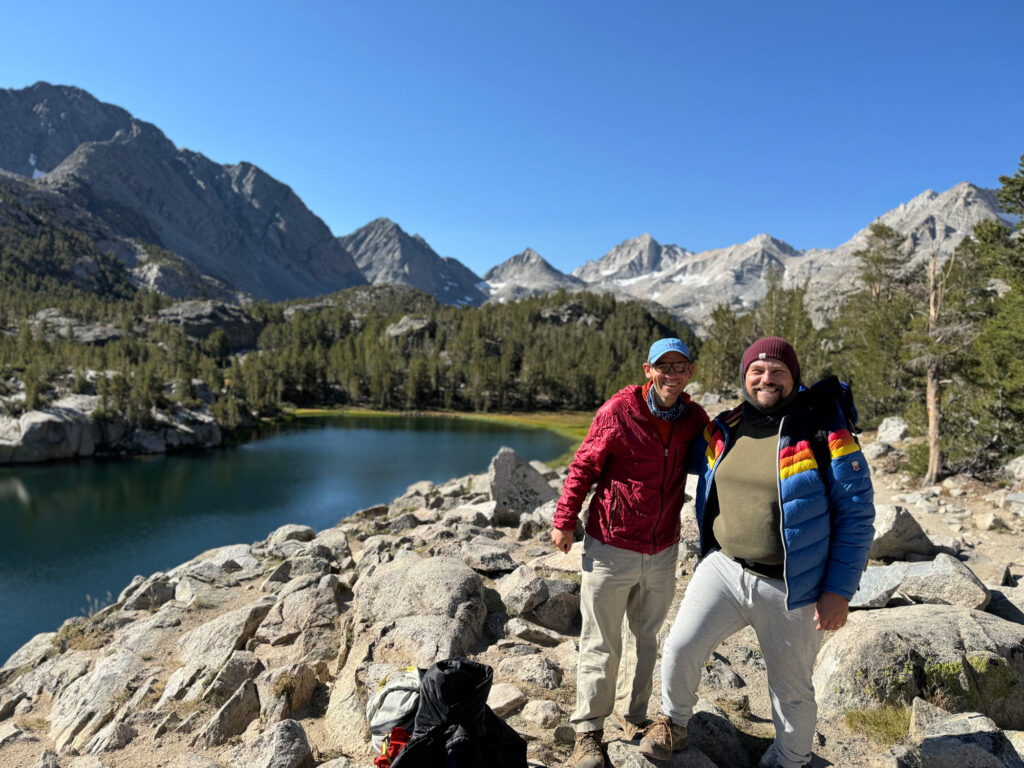
That’s Joel. He’s one of my best friends. We met in fifth grade at Hebrew School. I brought Joel on one of my family’s camping trips, and it was the first time he’d ever been camping. Now he’s a geology professor who regularly does field work alone on backpacking trips for weeks at a time. And now using Joel as my guide. I was going to hike the Pacific Crest Trail.
Jacob: What’s the elevation there? 8,000.
Joel: High, we’re probably going up to 12 or 13. If you think you get altitude sickness, we probably should not do something in the Sierra. There’s two types of like real altitude sickness that’s serious.
Joel: One is like a brain swelling thing, and one is–
Jacob: That’s terrible.
Joel: More of a lung thing.
Jacob VO: I talked to Joel about doing two weeks of the Pacific Crest Trail sometime in the summer.
Jacob VO: He lives in Reno.
Jacob VO: I live in Los Angeles, so Bishop and the Eastern Sierras are about halfway between us.
Jacob VO: The plan was we’d meet up there and then I was going to hike—two weeks of—the Pacific Coast Trail–Crest Trail. Fuck. I keep doing that.
Joel: Well the Sierra stuff is complicated ’cause you gotta get permits, and I think we totally missed the boat on permits.
Shit. Okay? So we missed the permits to do two weeks in the back country. And to make matters worse, Joel wasn’t sure if I was in good enough shape to do two weeks anyway.
Joel: As someone who hasn’t backpacked, like what would be good for you?
Joel: I think we could have a two day trip, we both leave our houses at like six in the morning we start hiking at 10
Jacob: So drive for four hours, then start hiking.
Jacob: That’s awful, but I guess yeah, why not?
Then we had to schedule….
Joel: Mid to late August starts to get a little bit harder because Thursday the 15th, one of my PhD students is defending,
Jacob: Is defending?
Joel: …for PhD.
Jacob: Oh, got it, got it. Okay.
Okay, now the plan was finally in motion, and I was going to hike—a six-hour stretch of—the Pacific Crest Trail.
Speaker 3: This unusual August storm. We still will have the chance of a few stronger gusts closer to the Sierra. …
Speaker: Dropping snow at the highest elevations like 8,000 plus feet…
Jacob VO: It was the night before I left to go meet Joel, and a storm was on track to hit the Sierras. Joel had the equipment to camp through the storm, and he wasn’t concerned about himself, but he straight up told me he didn’t think that I could do it.
[RECORD SCRATCH SFX]
A quick note here: snow can be really dangerous. Mt. Baldy, which is on the border of LA County, is a pretty tame hike, but in the last decade a handful of people each year have died trying to hike it in the snow. And where Joel and I was hiking, was more than twice as high.
Jacob: Do you consent to me recording this?
Heather: Sure. But I don’t consent to you using it unless I approve it.
Jacob: Jesus Christ. Okay.
I’m talking to my wife.
I started spiraling.
Heather: What’s the point of doing this?
Jacob: To like push myself and to practice.
Heather: I just think going backpacking is too ambitious for what you’ve realistically given yourself.
Heather: You’ve let yourself down in this particular way
Jacob: Over and over…
Heather: Over and over and over again, and you’re just like, I don’t know why I can’t be better.
Jacob: I eat too much of the wrong stuff and I’m not active enough. It’s all me. I don’t want to be stuck, but I can’t figure out how to get moving.
Heather: When you hurt your back. I was six months pregnant and I had to do everything for like two months physically with our son, I was so mad at you.
Heather: You said, I feel like you’re blaming me for hurting my back. And I said, I do blame you for hurting your back.
Heather: You didn’t like totally disagree with me.
Heather: I want you to be healthy and I want you to feel good about your body, and I want to feel good about your body. I am really proud of you for having that conversation with me.
I called up Joel and we decided we would sleep at a campsite a few hours away where there was no storm. And then the next morning I would hike a couple hours of the Pacific Crest Trail.
Jacob: Alright Joel, it’s 7:59. We’re at the mosquito flats trail head. It is 33 degrees.
Joel: 273.
Jacob: Kelvin?
Joel: Yeah.
Jacob: Can you convert Kelvin that fast?
Joel: Pretty much. Yeah.
Jacob: 10,228 ft. We’ll see if i make it.
[Jacob heavy breathing]
Jacob: We’ve done 2.75 miles or so… or 2.5 over all.
Jacob: Joel, how do you think I’m doing?
Joel: You’re doing great.
Jacob: If we see a good spot to sit in the sun, I might wanna do that.
Jacob: Honestly when we’re sitting like this I feel ready to go, but when we see a good spot to sit in the sun, I might wanna do that.
Jacob: Honestly, when we’re sitting like this, I feel ready to go. It’s just when we get up and start moving, my legs don’t move.
Joel: Yeah. But, so let’s, let’s, let’s push, you know.
Jacob: Dude.
Joel: Six football fields.
Jacob: I’m pushing. I’m pushing.
CEDRIC: Joel seemed to be impatient with how often I had to stop. He kept trying to take my pack.
Joel: Why don’t I take your trail up, or your pack, at least to the down hill?
Jacob: Uh, Am I stubborn? If I don’t let you?
Joel: You can take it if you want. But if you stop again before we get there, I’m gonna take it.
Jacob: I guess that’s fair.
In my defense, we’re hiking at around ten and a half thousand feet, an the air has a third less oxygen than I’m used to. And… um… not in my defense, here is some audio of a woman old enough to be my grandma passing me while making sure I wasn’t about to die:
Older hiker: How you doing? You have enough water?
Joel: Yeah.
Jacob: Yes.
Older hiker: You okay?
Jacob: Yeah.
Joel: Thank you guys.
Older hiker: Of course.
Jacob: Thank you.
Jacob: I think I define myself as a really outdoorsy person.
Joel: Mm-hmm.
Jacob: Because of my interests and what like fills me up inside.
Joel: Yeah.
Jacob: But if you looked at what I do on paper, lately, I am not really a very outdoorsy person at all. And I think that’s hard for me and my enjoyment of life and my sense of self.
Joel: Yeah. But that’s something you can change.
[some VO?]
Joel: So do you feel like you pushed yourself?
Jacob: I did feel like I pushed myself. I feel really good. I feel, um, obviously it was harder mentally than physically. Up to a point, and then it became much harder physically than mentally, and I’m surprised that my legs were what really gave out. Do you think you pushed yourself?
Joel: Sorry. No.
Jacob: That was a, sorry. No,
Joel: But that’s still nice to get a walk outside.
//
Jacob: My body has given out at the end of the way back. I push myself so much on the way there. There’s no much more. There’s no much more? There’s no, there’s not, uh, there’s no more for the way back, but I just need to sit for a minute.
[heavy breathing]
Jacob: I don’t want this to be how my body works.
Joel seemed to be impatient with how often I had to stop. He kept trying to take my pack.
Joel: Why don’t I take your trail up, or your pack, at least to the down hill?
Jacob: Uh, Am I stubborn? If I don’t let you?
Joel: You can take it if you want. But if you stop again before we get there, I’m gonna take it.
Jacob: I guess that’s fair.
THIS SHOULD GO SOMEWHERE
Joel: Well, how do you feel about trying to move some more?
Jacob: I should.
Joel: Lets do that, it’s been five minutes.
In my defense, we’re hiking at around ten and a half thousand feet, an the air has a third less oxygen than I’m used to. And… um… not in my defense, here is some audio of a woman old enough to be my grandma making sure I wasn’t about to die:
Older hiker: How you doing? You have enough water?
Joel: Yeah.
Jacob: Yes.
Older hiker: You okay?
Jacob: Yeah.
Joel: Thank you guys.
Older hiker: Of course.
Jacob: Thank you.
==
Jacob: Oh my gosh. This is probably the second most climb since the beginning.
Joel: I don’t know. I haven’t been paying that much attention.
Jacob: Holy shit. My whole body, just like, hurts.
When I got back from the hike, I felt like I had something positive to share with Jacob. I reached out and told him the news. And told him I wanted to do a massive cut to help me double down. I was expecting an attaboy, but instead, he reminded me that there’s no shortcuts.
Trainer JR: Everything that we’ve been doing has been setting you up for sustainability. Going crashing into it like this, while doable will not result in long-term success. It just won’t. You’ll get to where you wanna be in 18 weeks and then it’s going to hit you like a freight train.
I told him I wanted to be like him, and he was doing this big thing – his bodybuilding competition:
Trainer JR: I think I’ve stepped away from it now because this semester especially, I kind of sat back and reflected as like, why was I doing this thing? Well, it was to address, my eating, my sleep, and my stress management and my exercise. Well, over the last three years I’ve done that. And so, do I really need to do a show anymore?
Trainer JR: I don’t necessarily think so.
I feel like I was taking the wrong lessons from what Jacob was teaching me — he redirected me toward what his version of an intense recommitment would look like. And he spoke in my love language… a giant spreadsheet:
Trainer JR: Let’s say that, like, tomorrow you weigh in, you know, 246, this spreadsheet provides estimation lines. And so, this top line is an estimation of a 0.5% rate of loss per week.
Jacob got into the details of this meticulous spreadsheet, which showed how much fat I could lose over different periods of time based on the steady, incremental changes he suggested.
Trainer JR: That could legitimately take you down to 226 // Through a period of maintenance // I would expect a five-pound at most increase // that maintenance period going for 12 weeks // another 20 pounds off there// then we would go through another maintenance period. // So by July 3rd, next year down another 20 pounds takes you to about 194.
So you can see the how long this can take to get through. In a healthy manner. This is all estimated, but again, as we talked about in the beginning, I wanna reiterate the how long this kind of stuff can take.
Jacob: Gosh, my first reaction is fuck, a year from now, wha- what?
Jacob: We started talking a year ago. And I’ve made zero progress.
Trainer JR: You haven’t had zero progress over the last year.
CEDRIC: I brought up the times I’d ghosted him.
Trainer JR: Well, that was a five-month stretch. A year’s 12 months long. Yeah. What about the other seven months? What you did during those times was awesome. The habits that you have started to build are there, this foundation is growing. Like last year, you wouldn’t have wanted to do anything that, uh, that you’re doing right now. Well, now you’re doing it. Like this is progress.
Trainer JR: It’s all a journey.
Trainer JR: It always is and it doesn’t do us any good. Thinking back on the past, negatively, it does help us to reflect on the past to see what we might want to do going forward. And so I think you’ve done a really good job of that. You’re sending emails so much more frequently lately. Uh, it’s absolutely fantastic.
Trainer JR: And so I say all that. You’ve made progress. It just not on the scale, but it has been progress and it’s the kind of progress that leads to long-term success. So keep telling yourself that.
[ECHO OUT audio]
That recording from Jacob was more than a year ago. And, I never responded. Not only that… I didn’t lose the weight. I actually gained another 15 pounds. And by my next physical, I weighed 262 pounds.
I stopped wearing my wedding ring because now I don’t just have fat throat. I have fat fingers, and my wedding ring, which was a little loose when I got married, is now tight enough to cut off circulation to my finger.
Looking back on the videos I sent to Jacob, the first thing I noticed is the clothes I’m wearing. They’re clothes I don’t wear anymore, because they don’t fit, and I miss them. As much as I hated my body then, at this point I would love to trade it for my body now.
Jacob told me if I went looking for a quick solution rather than building healthy habits, I’d end up gaining weight instead of losing it. And, that’s exactly what happened.
Kind of a downer, huh?
[END CREDITS MUSIC COMES IN]
Jacob Reed and Me is a production of Same Name LLC in association with All Trades Co, End of The Road Films and can you imagine if we actually ended the episode that way?
[Power down SFX]
It’s true though. I did gain the weight. And it sucked. And I felt bad.
But, that’s not only thing Jacob told me, and it’s not the only thing he was right about. And, after I gained that weight, something happened I wasn’t expecting.
Trainer Jacob: Put your shoes on. Walk outside. Five minutes. That’s it. And that is an absolute step forward.
Trainer Jacob: You have awareness now of what you’re taking in.
Trainer Jacob: What you’re doing now is very much setting you up to lose that weight. Gonna take a little bit longer but then keep it off.
JACOB VO: Even though Jacob and I were no longer communicating. I kept hearing his advice and encouragement.
Trainer Jacob: I know what it’s like to go through periods where things are just absolute chaos.
Trainer Jacob: You’re going to crush this week.
Trainer Jacob: You’re not trying to bail at all. You are a human being.
Trainer Jacob: You’re going to crush this week.
Trainer Jacob: This happens to everybody. It happens to me.
Trainer Jacob: Whatever happens. It has happened.
Trainer Jacob: We get into slumps like this, but we always pull ourselves out.
Trainer Jacob: The longer we take to establish it, the harder it is to break it.
I started working on a few habits at a time.
Trainer Jacob: Highly filling foods have fiber in them.
Trainer Jacob: Just stay positive.
Trainer Jacob: Drink more water.
Trainer Jacob: Condense those snacks into meals..
Trainer Jacob: The weekend surplus effectively negates the work during the week.
Trainer Jacob: I know you got it in you. I know you’re capable. And we’ll get there.
And another year later, when I went in for my physical, I’d lost 15 pounds. And I’m still losing a little bit of weight each month. It’s not happening at the speed I wanted it to. But, it is happening.
And I felt like Jacob deserved to know about it.
Jacob: Uh, it has been a while. Um… I have really been putting off, um, reaching out to you because I feel embarrassed and ashamed at, um, ghosting you and wasting your time. And I also feel really appreciative. So my two-year-old is now a four-year-old. I think it was a really hard time in my life for me to decide I was gonna try to get my shit together and I feel like I’m in a slightly better place now. I was just struck by how supportive and informative you were, but also, um, just how much of it has really has stuck with me. And, uh, um… I really think you made a huge impact on me, and I just want to say thank you.
True to form. Even though it had now been almost two years since I messaged him, Jacob responded a few hours later — gracious as ever.
[MUSIC STARTS]
Trainer: Hey Jacob, thank you so much for sending your video through, man. I can’t tell you how excited I was to see the email and then be able to listen to the video. It really does mean a lot to hear that. I’m so proud of you for sticking with it. That’s the hardest part. I would absolutely love to catch up. I did look up the podcast, made me smile when I saw that it was — I think you had maybe the first, second episode out. I even read your dad’s book (fade out)
Every day, we see messages telling us about a quick fix.
- Subway’s New Atkins-Friendly Wraps
- Brand new South Beach Diet
- I’m Marie and I lost 50 lbs on Nutrisystem
- Sage Leaf Tea
- Gastric Bypass
- New Doritos Protein Chips
- I’m Serena Williams, 34 lbs down on GLP-1s
There are multibillion-dollar industries depending on that message sinking in.
But I learned that whether you like it or not, it takes time. If you have a supportive voice on your shoulder reminding you of what’s truly important, the long road may be the fastest way to get there.
It’s certainly better than anal leakage.
Family Guy Clip: Causing explosive diarrhea. You heard me. Mmm so good. [Stomach gurgle] Uh oh [Sound of Peter diarrhea gysering himself through the ceiling]
[CREDITS MUSIC ENTERS]
Jacob Reed and Me is a production of Same Name LLC in association with All Trades Co and End of the Road Films.
Our executive producers are Danny O’Malley, Alex Rivest, Adam Paul Smith, Chris Kelly, and me, Jacob Reed. Our co-executive producer is Margot Leitman. Today’s episode was produced by me. Our associate producers are Sophia Lanman, Sofi Pascua, and Simone Endress.
The show is written by Margot Leitman, Danny O’Malley, and me, Jacob Reed.
This episode was edited and sound designed by Madison Easton and me. With additional editing from Quinn Jennings, Will Ryerson., It was mixed by Rich Malstrom.
Our theme song was composed by Daniel Walter. Additional music by Daniel Walter, Epidemic Sound.
Our interns are Quinn Jennings, Dylan Keeffe, and Sam Walker.
Special thanks to our friends and family, and to Chris Berube, Mike Leffingwell, Yak Manrique, Matt Mazany, Barry Rothbart, and to Dexa Body in San Diego
And to our supporters on Patreon: Doppelganger Detectives, Sarah JB, Laruen W, Madison E, Marcus R, Michelle, R, Willy N, Carole R, Jared K, Eric E, Richard D
and to indie podcast darlings Jerome P, Andrea WC, Doggy Daddy, Carolyn S-R, Edith, Ben R, and Joel,
Get in touch with us at hello@JacobReedAndMe.Com. You can also leave us a voicemail with your “same name” story at www.JacobReedAndMe.com or by calling our same name hotline at 1-94-SAME-NAME.
This podcast was recorded in the Octavia Lab, a DIY makerspace named after celebrated science fiction author Octavia E. Butler, located inside the Los Angeles Public Library’s downtown Central Library. Visit lapl.org/labs to learn more about the free equipment and resources offered at the Octavia Lab. The library does not endorse or oppose the views or topics discussed on this podcast. However, I, Jacob Reed, wholeheartedly endorse the library. Libraries are the coolest… Your move, library. Your move.