Carissa: How ’bout now Jacob?
Jacob: Uh, light it up. I can’t see even where your light’s hitting, so Probably not.
Carissa: Okay.
It’s a couple summers ago, and I’m in a dry lake bed in the middle of the Mojave Desert.
Jacob: This is kind of silly, but I just want you guys to know that this was owned by a guy in his eighties.
I am with my friends, we’re under a sea of stars, and I’m giving a eulogy…for a piano.
Jacob: His family played it for at least 20 years that I’m aware of. It was last tuned in the fifties. According to the legend that piano tuners write their initials and erase the previous tuner’s initials, the last initial in there is 1951.
I’d taken piano lessons as a kid, and throughout middle school and high school, I dreamed of being a jazz musician. But I kind of dropped off. When I bought this piano, it was the first time I’d had one available to me since I was in high school. But I didn’t buy it to play it. I bought it to burn it.
Pyrotechnics Guy: 3, 2, 1
[PIANO BURNING]
If you’ve never heard the sound of a piano burning, it’s like any other wood fire. But with the whimpering swan song of the strings snapping one by one.
[STRINGS SNAPPING]
The burning piano was for a music video I directed for a friend, the incredible singer-songwriter Philip Labes.
[MUSIC VIDEO IN]
The chorus is about self-immolation.
Philip: Someone lit themselves on fire in the middle of the square. Feels like everything is ending and I am barely there.
[FADE OUT]
When we started planning this, we all agreed it felt sacrilegious to burn a musical instrument. We did our best to find a piano beyond repair, and we made sure to let anyone we were getting it from know what we planned to do.
When our free [plus $100 for delivery] piano showed up, the wood was warped, it was missing a few keys, but it still played beautifully.
[MUSICAL FRIENDS CLIP]
The piano was delivered a month before our shoot date. And since we have a very small house, it lived in our backyard for that whole month. The previous owners said it had been well-loved, but the last few decades, the piano had been ignored. And as the first few days of having a piano in our backyard went by, I started feeling guilty about it sitting there on some kind of musical death row, awaiting its fate.
So I decided to give it a send-off.
[PLAYING ALONE]
Every morning, I brought my coffee outside, set it on the piano, and played. Sometimes alone…
[PLAYING WITH WILDER CLIP]
Jacob: It’s a special treat.
Sometimes with my kids,
Wilder: This is really, really fun to play this piano.
And sometimes with my more musically inclined friends,
[MUSICAL FRIENDS CLIP]
But most of that piano’s final moments were spent with me, alone, pulling whatever muscle memory I still had from my childhood lessons,
[HEY BULLDOG]
[PINK PANTHER THEME]
[LINUS AND LUCY]
[JACOB NOODLING AROUND]
When I took piano lessons as a kid, they were at the nearby college, San Diego State University. My grandpa, who also loved piano, would drive me to lessons. We’d pass by the auditoriums where the SDSU Jazz ensembles practiced.
[BIG BAND MUSIC IN – BREAKFAST GALORE]
We’d always stop to listen to them play. Once I was old enough to drive myself, one of my favorite radio stations was San Diego’s Jazz 88. My dream was to be on Jazz 88 playing with some cool jazz ensemble, and then the smooth-voiced emcee would be like,
[OLD TIMEY EFFECT] “That was blah blah blah with so and so on sax, so and so on the drums, and Jacob Reed on keys.”
[MUSIC OUT]
But flash forward 30 years. And I wasn’t playing piano anymore. I was burning one.
[BURNING PIANO CLIP]
After we got our final shot, we turned off all of the lights and stared up in the pitch-black darkness at the Milky Way. It was an experience that stayed with me. Because long after the piano smoldered into ashes,
[THEME MUSIC / OPENING SEQUENCE]
I realized a spark had ignited something within me.
Bouncer: You’re the other Jake Reed?
Pasadena JR: He’s got the swagger of a front man we need.
Jacob: The closest thing I feel like I’ve seen to someone time travel
Columbus JR: I think that’s the meta level that we need to be at here.
Jacob: This is officially, the first time we’ve introduced other Jacob Reeds to Jacob Reeds.
Pasadena JR: This is getting weird, man.
Baltimore JR: Is this what happens when I get older?
Columbus JR: It hits you like a truck. You’re not going anywhere.
Jacob: I am so fucking nervous. I feel like I made a huge mistake.
SHOW OPEN: Welcome to Jacob Reed and me / and me / Jacob Reed and me / Jacob Reed and me / and me / and me / a docuseries / a mystery show / a rabbit hole / a mundane multiverse / an investigative comedy / that answers life’s biggest questions / life’s biggest questions / exclusively by tracking down people / tracking down people / named Jacob Reed / Jacob Reed / Jacob Reed / Jacob Reed / hosted by me: Jacob Reed.
Today on the show, number 253: The Musician.
Spending a month noodling around on a broken piano was some of the most fun I’d had in a long time. Once it was gone, I found myself missing it. I wanted to have one more chance at my dream of being a jazz pianist. So, I checked if there were any musician Jacob reads that I could talk to. And I found one.
There’s a Jake Reed who plays with the incorrectly named Jake Reed Trio. I mean, there are three people in his band, but doesn’t the name kind of imply that they’re all gonna be named Jacob Reed?
[KEYBOARD CLICKS]
Jacob: Jacob Reed Bio. Jacob Rosenthal Reed, often shortened to Jake, is an active drummer from Ohio. Got a bachelor’s in music education and master’s degrees in music composition and music theory from Ohio State University. I found what looks like his master’s thesis. A tetra helix animates Bach revisualization of David Lewin’s analysis on the opening of the F Sharp minor fugue from WTCI. Um, so this dude’s like a nerd. As if I’m not,
His thesis was full of words I didn’t understand, and an internet search didn’t really help.
Jacob: All right. What is a fugue? A musical composition in which one or two themes are repeated or imitated by successively entering voices and contrapuntally developed in a continuous interweaving of the voice parts. Huh?
I listened to some of the samples to see if I could get context clues
[CLIP FROM JR FUGUE THESIS]
Jacob: I mean, it sounds nice. I guess what I’m hearing is like a repeating pattern that, um, is altered slightly, maybe by key? Oh, here’s a graphic.
I saw an animation on Jacob’s thesis website and clicked on it, and what popped up was a DNA esque spiral where the nodes lit up as notes played.
[CLIP FROM JR FUGUE THESIS]
Jacob: This is what music theory is? Wow. This is cool. It’s like pleasing and mysterious, even if I don’t understand it.
The fugue stuff was kind of cool, but not really my wheelhouse. His jazz band, on the other hand,
[JR TRIO AUDIO – TEA AT THREE]
was exactly the kind of thing I was interested in. This Jacob Reed was literally living my dream of being a jazz musician.
Laura Camara: Bradley Mellen, Jon Eschelman, the man, the myth, the legend Jake Reed.
And thats’ when it hit me. I needed to start my own Jake Reed trio. But, my version would have three members named Jacob Reed. And, maybe forming that band would finally give me the chance to play on stage as a real musician.
[MUSIC OUT]
All I had to do was find two professional musicians named Jacob Reed.
Jacob: So let’s look at his Instagram. just ’cause he’s got a great mustache.
[PASADENA JR INSTA CLIP]
Jacob: I mean, He seems like pretty good. He seems like someone I might be friends with.
But as I watched more and more of his clips, something wasn’t adding up.
[MUSIC IN – UNEXPECTED MOMENTS OF CLARITY]
Jacob: Based in Los Angeles? Um, so the Jake Reed Trio is not the guy that we’ve been looking at. That’s a different Jacob Reed that does music.
As it turns out, there are two Jacob Reed who are jazz drummers, and both of them studied music in Ohio. Jacob Reed, the Fugue composer, stayed there and started the Jake Reed Trio. Jacob Reed, with the Cool Mustache, came out to LA.
I made a note to circle back with jazz drummer Jake Reed from Ohio. But in the meantime, I looked at the bio of jazz drummer Jake Reed from Pasadena.
Jacob: He has performed/recorded with Katy Perry, the Los Angeles Philharmonic, Seth McFarlane, The Baltimore Symphony Orchestra, he also does a lot of recording for TV/film. Published a drum set instructional booklet called Jazz Drum Set etudes. Released his first solo album, Reed Between The Lines. A man after my own heart.
[MUSIC OUT]
I reached out to him, and he invited me to his home studio, which was only a few minutes away from me.
Jacob: Hello?
Pasadena JR: Hello.
Jacob: Holy shit, man. Jacob,
Pasadena JR: I’m Jake.
Jacob: Nice to meet you.
Pasadena JR: Yeah, nice to meet you.
We found out that our college years nearly overlapped at USC. I had a work study job at the music school, and a few months after I finished my undergraduate studies, Jacob started at the same music school as a grad student.
Jacob: Did you ever miss a check from the USC School of Music? I got a check from them. Cashed it. Then I got a letter that was like, Hey, we sent a check to you in error. Can you please give us that money?
Pasadena JR: I mean, that was probably mine. Yeah. I was Peter Erskine’s teaching assistant.
Jacob: I designed concert posters for him.
Pasadena JR: Really?
Jacob: If you were part of like one of the ensembles I probably designed posters for you.
Pasadena JR: Oh my god, this is getting weird already.
And the already specific coincidences only got more specific.
[MUSIC IN – PLUMS AND CARROTS]
Jacob: We have the same candles,
Pasadena JR: my wife got those.
Jacob: My wife got them for me.
Pasadena JR: We met at USC,
Jacob: I met my wife at USC
And weirder
[MUSIC SHIFT]
Pasadena JR: Oh, I got, uh, some toe fungus.
Jacob: That’s my thing.
Pasadena JR: It happens dude.
Jacob: Yeah. By any chance do you go to a foot doctor called [BLEEP]
Pasadena JR: You’re the [snaps] oh my God.
Jacob: You’re the other guy.
Pasadena JR: I go to him too.
Jacob: Yeah. Okay. They keep calling me.
Pasadena JR: Oh my God, are you kidding me?
Jacob: That’s so funny. Yeah,
[MUSIC OUT]
With our fungus discussion over, Jacob gave me a tour of his studio.
Jacob: Oh, this is rad. I’ve seen this on your Instagram.
Pasadena JR: Yeah.
Jacob: This is pretty great sound in here.
Pasadena JR: It’s two layers of drywall. And in between the drywall is what they call green glue. It basically turns the sound into heat.
Jacob: Back there. There’s a, like the closet of shoes that Carrie has in Sex in the City, but with drums. And then I just turned around behind me and there’s like a, three times as big one
Pasadena JR: that’s a walk-in closet.
Jacob: Holy shit.
For someone who always wanted to be part of the music world. I was like a kid in a candy shop.
Jacob: What do you like to play?
Pasadena JR: I just like to play grooves. Really.
Jacob: Can we hear some?
Pasadena JR: I mean, I play,
Jacob: is that weird?
Pasadena JR: I play lots of things, but, um,
[PASADENA JAKE GROOVES OUT]
Jake was totally cool and humble and laid back. But after meeting with him, I asked some musician friends and the word on the street is he’s one of the best session drummers working today
Jacob: I mean yeah, you’re pretty fucking good on the drums.
When Jake found out my producer Danny, who is with us recording sound, worked on Chef’s Table, he started talking about a famous scene from Jiro Dreams of Sushi, the documentary about Sushi Master Jiro Ono.
Pasadena JR: You know how he talks about making the tamago, right? Where like, this guy has to make the egg sushi and if you don’t make it completely, perfectly you don’t get to like pass on to the next level. On the drums. This is our tamago.
[BASIC BOOTS N CATS BEAT]
Pasadena JR: that’s not hard to do, but to do it really, really well, is the hardest thing to do.
Jacob: What, what’s the difference between doing it well and not doing it?
Pasadena JR: So for instance, [SNARE + HAT IN UNISON] that’s at the same time, Well, that requires some coordination. And not everyone has that coordination, even if they play the drums, so they could be like, [SNARE + HAT SEPARATELY] so like [BOOTS N CATS BUT SNARE & HAT AREN’T IN UNISON]
Jacob: I see what you mean
Pasadena JR: and then if I,
[PLAYING FASTER]
Pasadena JR: I start getting too fast, that would be an example of not playing that beat very well. There’s like a sliding scale of how well you can play that beat, right? So, you know. This is my tamago. It’s just like,
[BOOTS N CATS IN UNISON]
Pasadena JR: and then from there you can build upon that.But it’s like, if you can’t do that, you got nothing. You have no foundation.
It was clear that Jake was an expert on the drums and exactly the guy I needed to help me bring my jazz musician dreams to life. So I told him about my idea.
Jacob: I had you mixed up with another Jake Reed who’s like a jazz drummer. He has a band called the Jake Reed Trio.
Pasadena JR: Yeah.
Jacob: I think that a band called the Jake Reed Trio, should be three people named Jacob Reed.
Pasadena JR: So good.
Jacob: And if you already have three people named Jake Reed or Jacob Reed in a band called the Jake Reed Trio, why stop there? And why not make it the Jake Reed Quartet or the Jake Reed
Pasadena JR: Orchestra?
We were getting ahead of ourselves.
Jacob: Have you ever started a band?
Pasadena JR: I have started a band.
Jacob: If I wanna start a band of Jacob Reeds,
Pasadena JR: Well, you gotta find other, you know, other Jacobs that are musicians. I play drums and you play piano. So we just need a bass player,
Jacob: But I haven’t really played piano in like 15 years.
Pasadena JR: You just, you’ll sit down and figure out.
Jacob: All right.
Pasadena JR: Um, someone’s gotta sing.
Jacob: Yeah. I hadn’t thought about that,
Pasadena JR: But if you just get enough of us, then we can just play whatever. We don’t even have to be good.
Jacob: It sounds like you’re down.
Pasadena JR: I’m totally down. Set it up.
And with that, the Jake Reed duo was formed,
[MUSIC IN – THE PIANO AND ME]
Jake was super nice, but I wasn’t sure if he really wanted to start a band , or if that’s just like a thing music people say to each other. The way improv people are like, Hey, we should do a show, and then nobody does anything for years. But then I got an invite to his next gig in LA.
[MUSIC OUT]
Jacob: I’m on my way to go see Jake Reed, the drummer, play at the Baked Potato. I think his wife is also playing. I’ve brought my wife because you don’t wanna not bring a wife to a wife fight. Or bring a gun to a wife fight? Um, that’s a joke I won’t use.
For how much I loved jazz as a kid. I realize I don’t go see it live very often, but now I was going to, and my name was on the marquee.
Jacob: A sign says the baked potato, and it has the headliner, and right below that it says, Reed. That’s me. I mean, it’s not me, but it is me.
I was outside the baked potato with Heather, my wife, and Danny, my producer. Finally, we got to the front of the line, and the bouncer was checking names off a list.
Bouncer: You’re the other Jake Reed?
Jacob: I am, yes. Did he tell you guys there was another Jake Reed coming?
Bouncer: There’s another Jake Reed. Crazy guy. The crazy Jake Reed guy.
Jacob: Yeah, I’m, I’m the delusional one.
Bouncer: Come on in.
[OLD JAZZ MUSIC IN – MIDSIDE NOTES]
The Baked Potato opened in 1970 on Studio City’s Cahuenga Boulevard. When you walk in, it feels like you’ve traveled back in time. There’s wood paneling everywhere, low ceiling, and tables everywhere, each one squared up, facing a very small stage. Nearly every seat is within 12 to 15 feet of the performers. So the seating is packed.
The walls are completely covered with memorabilia, autographed photos, record jackets, half a century’s worth of jazz history. From rock legends like The Doors’ Robbie Krieger to the most in-demand session musicians in LA. You can feel the history.
[MUSIC OUT]
Jacob: We’re gonna be back here?
[BAKED POTATO AMBIENCE]
We shimmied into a wall-hugging green vinyl booth, bathed with crimson lighting, and were handed laminated menus. And on the menus were 24 different types of baked potato. I ordered one, I don’t remember which kind, and I really need to put it into context, how big it is. They’re massive. They’re like footballs.
[MUSIC FADE IN – MIDSIDE NOTES]
If you like jazz, The Baked Potato is one of the most intimate places to catch a show. And if you don’t like jazz, you should go just to experience the potatoes.
[MUSIC OUT]
[TRIO KATE SET INTRO]
Jake played in a group with a few other musicians, including his wife, Kate.
[JAKE REED DRUM SOLO]
[APPLAUSE]
Jacob: Isn’t that weird?
Heather: Feel what?
Jacob: I was saying to Danny that I leaned over and I was like, I did that. When I didn’t do it, obviously, but like I feel ownership that he. He nailed it. Because it’s it’s my name.
[APPLAUSE]
Andrew Synowiec: Thank you for coming to the Baked Potato. On the drums, Jake Reed.
[APPLAUSE]
Andrew Synowiec: And we’d also like to acknowledge, there’s another Jacob Reed in the audience. If you could just stand and everyone could applaud.
[APPLAUSE FADE OUT]
This shout out was a total surprise. Seeing Jake play was awesome. It inspired me. After the gig, I was itching to sit down at a piano and start playing. But when I had the old piano in my backyard for the music video, all I knew how to play were the few pieces I retained from my childhood lessons. I didn’t really know anything about chords or how to put stuff together.
And for all the years I was actively playing and taking piano lessons, one of the things I remember most clearly was messing up in front of a huge audience. I’d just transferred to a new school. It was the fourth grade talent show. Unlike the sonatinas and classical pieces that I’d practiced, I wanted to play a song that I loved: Linus and Lucy by Vince Guaraldi.
You probably know it as the Peanuts song.
I was so nervous, at one point I went totally blank and had to start over. I felt like such a failure. I don’t think I quit right after, but the fact that that’s one of my main memories of playing piano is telling.
[MUSIC IN – UNEXPECTED MOMENTS OF CLARITY]
Actually, thinking back on it, I didn’t remember much about my piano lessons at all — other than they were with Dr. Kolar, a professor at SDSU. And, come to think of it… Wasn’t it kind of weird that as a kid, my piano teacher was a college professor? Why was that? And, why did I quit? I set up an appointment with the keepers of family records… my parents.
[MUSIC OUT]
David: How do I turn my camera on
Carolyn: in the bottom there’s a little, um,
David: I got it.
Carolyn: Okay.
David: Okay, Jacob Reed.
The first thing I wanted to know is why did they sign me up for music lessons in the first place?
Carolyn: Kids studying music was always really important to me. Music helps develop your brain and it helps you problem solve and I just knew how important music was for life.
David: I remember the uh, community music school, was it?
Carolyn: Yeah, we lived close to San Diego State, so I looked at the music department and Dr. Mitzi Kolar she would teach her grad students to be music teachers and so those students led this class.
David: I walked in everybody was playing scales. and she said something like, okay, now change to F And everybody was doing their scales in a different thing. I was blown away.
Now that they mentioned it, I did remember that piano class The group class taught by Dr. Kohler’s grad students was how I started learning the piano. But at some point, I transitioned to private lessons with Dr. Kolar.
Carolyn: She didn’t teach everybody. She liked you, you two connected. you were one of the young promising ones
Hearing this was surprising.
[MUSIC IN – WHEN THINGS START TO SWING]
I had potential. Is this just what moms say because they all think their kids are great, or did I actually have some kind of musical ability? If I’d focused more, would I be living my dream? And what about Dr. Kolar? I remember her being strict and intimidating, but she actually went out of her way because she liked me.
Carolyn: I remember came to your bar mitzvah, that you were still working with her when you were 13. You wanted to continue. It fit your brand, you know, of what you were into as a kid.
Jacob: What was my brand?
[Dad laughs]
Carolyn: Being curious about things, wanting to know how they worked, wanting to learn how to do them, you were always into building LEGOs and that kind of music was building.
My current brand is pretty much the same, except for, in addition to LEGOs I now make massive spreadsheets full of Jacob Reeds.
[MUSIC OUT]
Talking to my parents made me wonder if Dr. Kolar was really as intense as I remembered. It turns out, she was easier to find than most of the Jacob Reeds.
Mitzi Kolar: Oh, I, I remember you. You were such a great young boy. You always came in with a smile. You’re playing these jazz pieces and you did them very well.
As I suspected, Dr. Kolar wasn’t just some piano teacher.
Mitzi Kolar: If you can believe it, I’m celebrating 50 years in San Diego, one of my specialties was piano pedagogy or piano teaching. In the late eighties, I was a consultant to the Yamaha Corporation, and I created a keyboard-based curriculum for kindergarten through eighth grade. And at one point, Yamaha said that more than 6 million children a week, around the world, were studying that curriculum.
Jacob: I mean, not even counting these millions of students that have taken this Yamaha course, do you have any estimate of how many students you’ve taught?
Mitzi Kolar: A lot, into the thousands at this point in time. And yeah, if you start counting the material I wrote for Yamaha. Then it’s, yeah, into the millions.
And one of those students was me.
Jacob: My memory is that I wanted to do jazz and that you insisted that I do scales…
Mitzi Kolar: You would’ve done jazz pieces with me. In fact, I’m sure I had you in a collection. And we did some of the music that you truly loved. Yes, I made you do scales, because scales are important to a jazz musician. That’s what they improvise on.
My childhood memory of Dr. Kolar was a strict teacher who wouldn’t let me do any of the fun stuff. But that’s not the woman I was talking to. She was kind, sweet, and very supportive. The scales that I hated so much were actually the thing that I needed most to become the jazz pianist I wanted to be.
[MUSIC IN – SAPPHIRE DREAMS]
Jacob: I remember like stopping piano as this big moment. And I’m trying to figure out why I ever stopped.
Mitzi Kolar: You know, it’s typical, uh, you were 12, 13 and other interests start coming to the floor. Sure, I was probably a little bit sad that I lost you. But I’m only hoping that some of that creativity that you had in your piano lessons broadened your scope, and allowed you to be in comedy or in film production.
Up to this point, I was viewing this as so binary. I took lessons. My teacher was intense. I quit. But I quit because I had other interests. there are countless studies that show music education in young people helps them be creative and solve problems later in life. I mean, that’s literally why my mom said she wanted me to take music lessons. And here, Dr. Kolar is saying the same thing. It wasn’t a loss. It was part of my journey. Maybe all I had to do was start practicing and I would unlock the power of music within me.
[MUSIC OUT]
I had some practicing to do, but practice on what? I burned my last piano.
[MUSIC IN – BROKEN CONVERSATIONS]
Lucky for me, someone in my family knows a lot about keyboards. Our cousin Marcus founded a music company called Line Six.
I’m not a music person, but I had a free t-shirt from them that I’d wear to the gym in college. And whenever I’d walk through the music school to get to the gym, people would be like, “Hey, Line Six. Cool.” And that was kind of all I knew about the company.
So, I called up Marcus.
[MUSIC OUT]
Marcus: So I would recommend something that’s 88 notes and weighted keyboard. I mean, you could borrow one of mine.
Jacob: Are you for real? ‘Cause I would absolutely do that. Do you have extras?
Marcus: Anyone who would see my setup would probably say, of course I have extras.
Cousin Marcus: You know, there’s an open invitation. So, just let us know when you want to come up
A few weeks later, I took that open invitation and drove out to see Marcus’s keyboard situation in person.
Marcus: This is our, this is our, uh, live room.
Jacob: This is rad
Marcus: For jams and stuff.
Jacob: Yeah.
Marcus: This is the studio, the rest of the toys.
Jacob: Wow….. Holy shit.
We walked into a room which looked somewhere between a home office and the inside of a 1980s spaceship.
[MUSIC IN – ARCADERS]
There was a computer straight ahead and to left and right were walls of musical equipment and switchboards with knobs, lights and wires going from one to the other. And of course, keyboards.
Jacob: What is this? 15? different keyboards on this wall?
Marcus: This is,
Jacob: This is crazy.
Marcus: This stuff’s a, a lot of this stuff’s older than you guys, so I designed most of those.
Jacob: Wait, you des— these ones that are on the wall, you designed working for that guy?
Marcus: Oberheim, that company Oberheim.
Quick side note – our EP Danny O’Malley who was with me recording audio is a huge synth nerd. The whole time we were with Marcus and the entire ride back, Danny was geeking out. If you’re a synth nerd like Danny is, we’ve got a bonus extended interview with me, Marcus, and Danny on our Patreon. But for the non-synth nerds, the TL;DR is if you’ve listened to any music made in the last 40 years, you’ve probably listened to something made on keyboards designed by Marcus.
[MUSIC OUT]
Marcus: So right now I have this keyboard.
Jacob: Every one of these you could play on this wall.
Marcus: Oh yeah.
[SYNTH DEMONSTRATION]
Jacob: What?!
Marcus: These should all be doing something.
Then Marcus started to give me a short synth lesson.
Marcus: So there’s the whole notion of a modular synthesizer. It’s the synthesizer equivalent of when a guitar player has a pedal board. And so different modules do different things. So these are oscillators. If I send zero volts
Marcus: I hear that pitch. If I send one volt, two volt, three volt, so on. Or you can let it play itself with things like a little sequencers and stuff like that.
And then his synth lesson turned into a physics lesson,
Marcus: Then there’s this notion of harmonics. It’s vibrating at lots of different frequencies at the same time. so I’m gonna take just one oscillator. This bottom one and we’re gonna listen to a sine wave. So it’s a very pure wave.
Jacob: Oh yeah.
Marcus: That’s a sine wave. This is a sawtooth wave here. It’s much buzzier.
Jacob: Yeah, yeah, yeah, yeah.
Marcus: It’s the same pitch. We hear the same tone.
Jacob: It’s just rougher around the edges.
Marcus: I’m changing the shape of the waveform. We still hear the initial pitch, but we hear a different timbre.
Jacob: So that’s like, how a synthesizer creates different sounds. The same way that different instruments would make different sounds.
Marcus: Right. I mean that’s is kind of, is intended to be orchestral like
Jacob: Yep.
Marcus knew so much, not just about synths and keyboards, but about the physics and biology of listening to music. At one point, I asked why I needed an amp, and instead of rolling his eyes at my stupid question… he lit up.
Marcus: Your eardrum is the source of how you interpret everything. Your brain gets signals, and it becomes words, right?
Jacob: Okay.
Marcus: Your eardrum is a physical membrane. That physical membrane can only be in one position at a time. It can be pushed in or pushed out with air pressure.
Jacob: Okay..
Marcus: So where people, their minds get blown is like, okay, I kinda understand how that works if I, like, whistle a single tone, but then what happens when I’m listening to an orchestra? All the sound pressure that’s going up and down all over the place at different frequencies, different amplitudes, they all sum together. The hairs in your cochlea vibrate depending on what frequencies are moving, and your brain interprets all that, and we can hear all these different sounds. It’s not only we can hear the sounds, we can tell when someone’s talking behind us because of how it bounces off our ears differently.
Jacob: That’s crazy.
Marcus: Well, hearing is very crazy.
I came for a keyboard, but I felt like I microdosed a music education: The history of synths, the physics of sound waves, and I know that this is cliché, but music is awesome. I didn’t fully appreciate the complexity of what happens when we listen to music. It’s kind of a miracle that it’s even possible. After all this talk, I, I just wanted to get my hands on a keyboard.
Marcus: This is what’s considered a weighted keyboard; it’s sort of piano-like
Jacob: okay.
Marcus: Not exactly, but
Jacob: That’s okay. I have to just like learn where the notes are and what they do.
Marcus: Take this stand and this keyboard and a sustain pedal, and you use your headphone jacks and you’d be set.
Marcus helped me load the keyboard into my car, and then I went home so I could finally start practicing, but I had no idea what to practice. I needed to figure out what I would be playing. And to make that decision,
[MUSIC IN – THE PIANO AND ME]
I needed a band. After the break, we see if we can make the Jake Reed Duo a Jake Reed Trio.
[MUSIC OUT]
I needed to form the Jake Reed band. I combed through my spreadsheet for any musical Jacob Reeds I could find, and brought them to my resident expert and only other member of the Jake Reed Duo so far: Drummer Jake Reed. Let me be more specific. Jazz drummer, Jake Reed. Nope, more specific still. Pasadena Jazz drummer Jake Reed.
Pasadena JR: I’m ready.
[MUSIC IN – SNOOTY FOX]
We started with the search for our potential frontman.
Jacob Reed #707 was in his early twenties and was all in on bringing back Frank Sinatra-style crooning.
[MUSIC OUT]
Cornwall JR: [singing] And did it my way.
Pasadena JR: Well, he’s an old soul, like most of us Jacob Reeds
[MUSIC IN ]
Jacob: So here you see him with like the old school, Frank Sinatra microphone. He’s got the hair slicked back.
Pasadena JR: The thing is he’s got a good tone. He is not trying to sing like Frank, you know, because no can
Jacob: I mean, it’s hard to associate that voice with this teenage looking dude.
Pasadena JR: He’s got the swagger of a frontman that we need.
I found a phone number for Jacob Reed’s mom, who deals with all of his “Inquiries” spelled the British Way.
[British phone trill]
Cornwall Mom: Hello.
Jacob: Hey, my name’s Jacob Reed. I am trying to reach the other Jacob Reed.
Cornwall Mom: No, he is not available.
[MUSIC OUT]
We had another Jacob read we were considering for our lead singer and frontman. Jacob Reed #751 needs no introduction from me because his recording company made one for him:
[TWANGMEISTER MUSIC IN]
Twangmeister VO: Twang meister records presents going home, a country gospel CD from Gospel singer songwriter Jake Reed.
Twangmeister Jacob: [singing] Spread the news. Spread the news across the nation that Jesus he is coming for to stay
Pasadena JR: Wow.
Jacob: It’s a different vibe.
Pasadena JR: Is he in the UK also?
Jacob: He is, yeah. So here’s picture and a little bio.
Pasadena JR: Born in 1939.
Jacob: I think he’s still around and he’s 84 or 85.
Pasadena JR: Wow. I mean, if he is down to travel from the UK at 85, then maybe it could work out.
[MUSIC IN]
[UK Phone trill]
Dan Twangmeister: Hello.
Jacob: Hey, I’m trying to find Jake Reed who is with Twang Meister Studios.
Dan Twangmeister: Ah, okay. I have sad news. He’s no longer with us.
Jacob: Oh, I’m sorry to hear that.
Pasadena JR: I think you have to be the leader. You’re the front man.
So not only did I need to learn to play the keyboard, I also had to learn how to be the frontman of a band. For this to work, I needed some solid Jacob reads to back me up. I needed someone like Jacob Reed #650, the heavy metal guitarist from Baltimore.
Pasadena JR: Wow based on the hair and stank face he is getting high marks from me so far.
Jacob: Graduating from Duquesne from 2024, Jacob moved back to Baltimore City. He’s young and has been finding his way into the music scene locally ever since. Jacob grew up with bands such as Rush and Metallica,
Pasadena JR: Oh, cool.
Jacob: before developing a love for progressive metalcore and other heavy genres. I mean, he’s so, he is like a metalhead.
[MUSIC OUT]
[BALTIMORE JR JAMMING]
Pasadena JR: Wow. So far, he can be lead guitar. I think he’s in the band.
I found Baltimore. Jacob Reed’s work number.
Baltimore JR: Hello.
Jacob: Hey, is this Jacob?
Baltimore JR: It is.
[MUSIC IN]
Jacob: This is not a prank call. I know it probably sounds like a prank call. I’m, um, trying to start a band. of other Jacob Reeds together who all play music
Baltimore JR: that is a wild idea. I’m actually at work right now, so I will have to talk to you another time.
Another time. Turned out to be the next day,
Baltimore JR: hey, how’s it going?
Jacob: Thank you for, being down to trust a stranger with a very weird call that I made to you yesterday.
Baltimore JR: I told my girlfriend about it. She was like,
[MUSIC OUT]
Baltimore JR: It’s like insane. You gotta, follow through on this.
[MUSIC IN]
Okay, so he’s in.
Pasadena JR: Is there more
Of course, there’s more Jacob Reeds. We have Jacob Reed number 253.
Jacob: This guy does a lot of stuff with the organ.
[MUSIC OUT]
Pasadena JR: cue the organ jokes.
[PORN DING]
[ORGAN JR SHREDDING]
Pasadena JR: Yeah, he’s shredding. Playing organ’s, kinda like flying a helicopter. With drums, I’m using all four limbs, but I’m not playing different notes on a keyboard with my feet.
Jacob: Oh, I hadn’t thought about— Yeah, you’re right. You’re right, you’re right.
But organist Jacob Reed was not so enthusiastic about the idea.
Jacob: I sent this guy an email, and he just replied with, “No thanks!” with an exclamation mark.
Pasadena JR: Dang. Okay.
Jacob: That’s a pretty hard no. Right?
Then there was Jacob Reed #26, the classical cello prodigy.
[CELLIST JR PLAYING]
Pasadena JR: Well, he has a beautiful tone. I can hear that.
I couldn’t find contact info for that Jacob Reed, but I did find a phone number for his mom.
Jacob: I left a message that was probably pretty weird. It was like, “Hi, I saw some articles about your son. Can you put me in touch with him?” I am a strange man from the internet. Like, that’s not how it came across, but like, maybe that’s how it came across.
If you’re following along, the Jake Reed Band so far is a Jake Reed Trio. Me on Keys, Pasadena Jacob Reed on drums, and Baltimore Jacob Reed on guitar.
Pasadena JR: So far, yeah, we got a band.
But there was still one last Jacob Reed we hadn’t reached out to: the drummer from the Jake Reed Trio.
[JAKE REED TRIO PLAYING]
Pasadena JR: He sounds good. He’s a proper, like, jazz drummer.
[JAKE REED TRIO PLAYING]
Pasadena JR: Clearly, he is very proficient. He plays with Dynamics. He’s got a good time, feel. All the things I look for if I were starting my own band, and I was like, I need another guy named Jacob Reed on the drums. I think he’s in the band.
Finding Ohio drummer Jacob Reed was easy ’cause I still had his info from when I thought he and Pasadena drummer Jacob Reed were the same person. Turns out, that’s a common mistake.
Columbus JR: That’s right. ’cause there’s a Jake Reed who’s a jazz drummer. Who lives in la And the only reason I know about him is Here in Columbus, we have a wonderful drum shop. And when I go in there and buy stuff, the young kids who are checking me out are like, so which of the Jacob Reeds are you?
Jacob: When you emailed me Your first question was if I was a different Jacob.
Columbus JR: Yeah. I think it was in searching for the Jake Reed LA drummer , and I was like, who’s this Jake Reed LA drummer who I’m competing with for websites? And then it turned out it was actually you
Searching for one, Jacob read and then finding another. Jacob read who you thought was the same. Jacob Reed, but actually turns out to be a completely different Jacob. Read. Welcome to the Club Pal.
Columbus JR: So I’m a jazz drummer. I’m a composer. Most of my composition stuff is like contemporary classical stuff, but I also write some jazz things.
Of course, I had to ask him about his thesis on Fugues.
Columbus JR: Fugues are cool because they’re this beautiful combination of musical expressiveness, but then also nerd math patterns.
[MUSIC IN – BACH FUGUE IN C MAJOR]
Columbus JR: Fugues and Bach in general play with that in a really cool way that is both exciting to just listen to, but then also to learn about how it’s all working.
Jacob: I knew that Fugues had like a kind of baroque vibe. And they do sound mathematical in some kind of way. It reminds me of what a visual fractal, like what that would sound like would be a fugue.
[MUSIC OUT]
Columbus JR: Patterns and fractals and, music and math. There’s a lot in there. Fugues were very popular in the baroque period, so that’s why that’s an association not only for you, but for other people. But I’ll toss out another set of fugues that I really like, which is Shastakovich Prelude and Fugues.
[MUSIC IN – SHOSTAKOVICH FUGUE IN A MAJOR]
Columbus JR: Decidedly not Baroque, right? He’s sort of a, a modernist, and I think he’s definitely writing preludes and fugues as a echo of Bach’s preludes and fugues. and they are weird and they’re out there and they’re still doing that kind of mathematical patterny thing, but they have way less of the trappings of Baroque music and more pushing the boundaries of harmony experimentation.
Columbus JR: And it’s not my only door into why I love music, but it’s one of the doors that I like to walk through all the time.
[MUSIC OUT]
So Jacob loved pushing boundaries with music, but would he also like pushing boundaries with names? Like being part of a band comprised of only Jacob Reeds?
Columbus JR: Yeah, sounds great. Sounds like a lot of fun.
And with our fourth Jacob Reed officially on board, the next step was to have our first band meeting.
[MUSIC IN – ALBERTO’S BEST DAY]
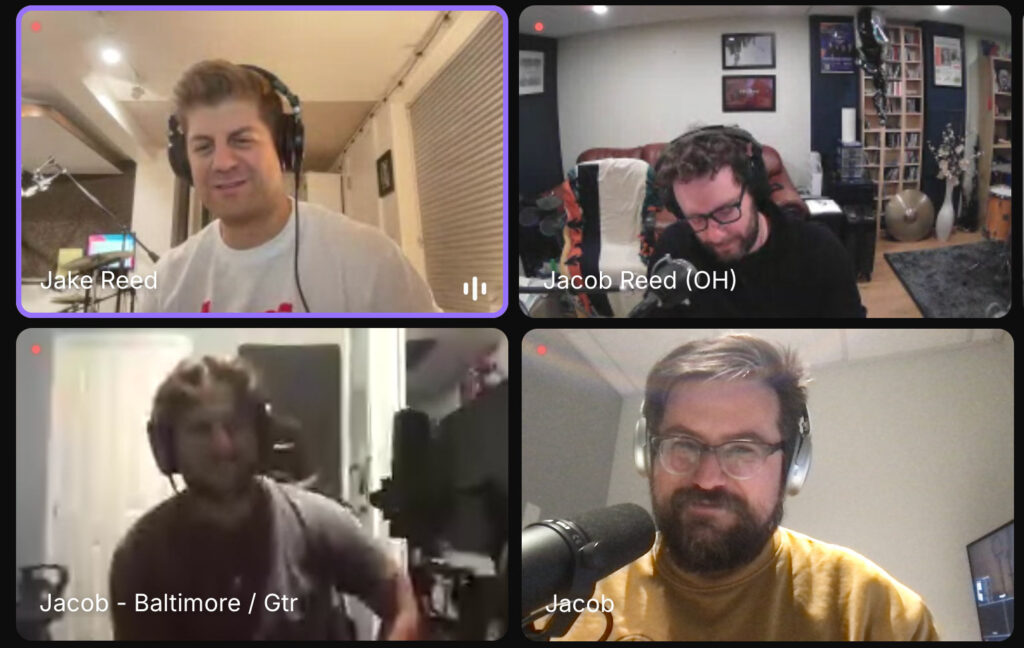
Jacob: This is officially the first time we’ve introduced other Jacob Reeds to Jacob Reeds. So, Pasadena Jacob Reed, meet Baltimore jacob Reed. Baltimore Jacob Reed, meet Columbus Jacob Reed.
Baltimore JR: Hello?
Columbus JR: Hey!
Pasadena JR: Uh…
Baltimore JR: This is.
Pasadena JR: …This is really weird.
It was really weird, but as weird as it was, the video call started the way most video calls do: with introductions.
Jacob: Uh, I am, the Jacob Reed who reached out to all of you and I have now obtained a keyboard, and I’m trying to practice, oh, and I’m in, Los Angeles
Pasadena JR: Where you living now?
Jacob: We’re in like East Pas.
Pasadena JR: Oh, well. I should differentiate by saying I live in South Pasadena, in case there’s any confusion. I play drums. I know it says “Jake” in my name, but I’m actually Jacob on my birth certificate.
Baltimore JR: I live in Baltimore. And I play guitar and… working on playing bass, not just in a guitar player way.
Columbus JR: I’m Jacob Reed.
[EVERYONE LAUGHS]
Columbus JR: It sounds, it all sounds the same. I live in Columbus, Ohio. I play drums. I don’t know what else.
Pasadena JR: This is awesome.
Jacob VO: I know having four Jacobs in a conversation is probably confusing to listeners. But I gotta tell you, even for us Jacobs who could see each other, it was really hard to keep track of what was going on.
Baltimore JR: So wait, are both of you drummers? Is that what I’m hearing?
Pasadena JR: Yeah.
Columbus JR: Mhm.
Pasadena JR: Yeah.
Baltimore JR: Okay.
So we had four Jacob Reids who could play music.
[MUSIC OUT]
But did we have a band?
Jacob: Are we missing key instruments? Would it suck if it’s just a guitar keys and two drums?
Baltimore JR: I feel like a good bassist is a nice thing to have,
Jacob: Well, Baltimore, Jacob, you said you’re learning bass.
Baltimore JR: I’m not giving myself enough credit. I already know how to play the bass.
Jacob: We need you on guitar.
Pasadena JR: Baltimore Jacob can rip on guitar!
Columbus JR: I feel like piano and guitar cover the same ground in a lot of ways.
Baltimore JR: They do.
Columbus JR: And so if you pressed me to choose between the options, I would want to know more about what kind of music we’re trying to create
Baltimore JR: That is a big fat question I have.
Jacob: I think it’s going to be jazz
Baltimore JR: If we’re going uh jazz, I studied the jazz stuff in school. I’m not going to be the greatest jazz guitarist you’ve ever met but I can definitely brush up.
Columbus JR: I mostly play jazz drums, and I write a little bit of jazz, but actually mostly write classical, like orchestral stuff.
Baltimore JR: You could write a classical intro to this epic
Jacob: That would be rad. I don’t know that I could play any classical intro.
Pasadena JR: Dudes. Jacobs, like Ohio, Jacob writes a big epic intro. And then we start rocking,
Baltimore JR: I like it.
Pasadena JR: Then we go into like, a jazz, uh, free jazz odyssey, maybe?
The call was going so well, it ended up going really long, and I had to leave in the middle of it.
Jacob: Wait, I’m just gonna step outside of this…
Columbus JR: uh, Pasadena. Jacob, are you getting kicked outta the library like while we’re on the call?
Jacob: Yeah. But, um, I’m just gonna go to a different area,
While I was finding a new spot. We got a little off track.
[MUSIC IN – PLUMS AND CARROTS]
Jacob: Does anyone else have a toe fungus besides, uh, besides–
Pasadena JR: Yeah, both of us do. We have the same podiatrist.
Jacob: –besides the Pasadena Jacob Reeds?
At this point. Ohio Jacob read sheepishly raised his hand.
Pasadena JR: Ohio. Jacob does too. Yeah.
Jacob: Wait. Do you really? Wait, what toe do you have a fungus on?
Columbus JR: Um, right foot, big toe.
Jacob: Yeah.
Columbus JR: Oh my god.
Pasadena JR: This is getting weird, man.
Columbus JR: Mine’s gone, by the way. I’m clean.
Pasadena JR: Mine’s almost clean. I got the laser treatment done, Jacob. You might want to ask Doctor [BLEEP] about that next time you see him.
Jacob: I did it. Back in January he full-on ripped off my toenail.
And if three Jacob Reeds in their forties talking about a toe fungus doesn’t scare you, it might be because you are not a Jacob Reed in his twenties.
[MUSIC OUT]
Baltimore JR: Is this what happens when I get older?
Columbus JR: Yes.
Jacob: Yes it is. It is.
But eventually we got back on track.
Pasadena JR: You’re a writer, so like you’re probably a good lyricist.
Jacob: Does anyone sing? If, Like if we do vocals?
Pasadena JR: I’m, not great.
Baltimore JR: I can hit the notes, but it doesn’t sound pretty.
Pasadena JR: Maybe it’s like a Spinal Tap situation, where you just write hilarious lyrics
Jacob: I could write a song about trying to find other Jacob Reeds to be in this band.
Columbus JR: I think that’s the meta level that we need to be at here. Right? It should be Jacob Reed singing a song about trying to find Jacob Reeds to be in a band, which does feel awfully like Spinal Tap.
Pasadena JR: It totally, yeah. And like, but there’s like two drummers and like the, but like, we don’t die, you know.
Columbus JR: We don’t die. Right. Yes.
I’ve never been in a band, so I’ve never had a first band meeting, but this felt like we definitely had chemistry. I was actually really surprised we all had a similar sense of humor.
We decided to play one jazz standard and one original song. For standard, I suggested Linus and Lucy by Vince Guaraldi — the song I remember choking on in my fourth-grade talent show.
The version I played in fourth grade was a simplified version for kids. So my first step was trying to find the real sheet music and to see if I could read it.
Jacob: Uh, it’s got four flats. Uh,
I wasn’t inspiring confidence.
[PLAYING 2 NOTES]
Jacob: So that’s.
[PLAYING SCALE]
Jacob: So that’s a flat. Okay, so it’s an A flat, which means,
[PLAYING LINUS AND LUCY INTRO]
Jacob: Yeah, that’s right so far. And then it’s, um,
[PLAYING FIRST NOTES OF MELODY]
Jacob: okay. I will switch to.
[PLAYING LATER MELODY]
Jacob: Dude, I might actually be able to pull this off.
The immediate confidence I got from muscle memory was just as immediately dashed when I realized that back in elementary school, I hadn’t actually learned the full song.
Jacob: What is this part up here?
[PLAYING CHORD]
Jacob: It’s still a flat, but it’s E-flat seven.
[READING NOTES]
Jacob: I am realizing there’s like a little bridge to this that I don’t think I ever learned.
But I kept practicing.
[LEARNING NOTES]
and practicing
[STUMBLING THROUGH]
and practicing.
[PLAYING THROUGH]
Jacob: Dang. I learned that. That’s rad. I barely even read the music.
Then there was the small matter of writing a perfect original song. How hard could that be? I started thinking about lyrics and once I had a rough idea, I jumped on a call with Columbus Jacob, the drummer who was also a composer.
Jacob: I love, by the way, that your face is just like, I’m down, but this crazy guy hasn’t given me enough information yet.
Columbus JR: I am told regularly that I’d be a shit poker player that like I don’t hide anything on my face
Jacob: So it kind of starts off it’s like when we’re younger, parents tell us we’re their special little guy, a special little snowflake, which I don’t wanna say special twice, but that’s fine. We’ll figure that out. The apple of their eye. Uh uh. Something, something, something, something. Something. Then there’s nobody quite like me, is the chorus. Like, cause the whole point is like, we’re, we all have the same name. Is any of that useful?
Columbus JR: I think very,
Jacob: What would be my next step
Columbus JR: I think you should finish the lyrics.
Jacob: Okay.
Columbus JR: I think you should write down the melody.
So I got to work.
[SOUNDING OUT MELODY]
Jacob: Younger parents tell us or the the f of their apple, of their, I.
I sent all my noodlings to Columbus Jacob, and he started turning it into a real song.
Columbus JR: Okay. I am also super tired and I’m trying to hack through the faster part. I haven’t solved r slash bread staple to trees. Placement in the rhythm. Is that a Reddit tag? I’m not used to setting Reddit tags to music. Okay, here we go.
[PLAYING MELODY WITH CHORDS]
Jacob: Yeah, I think it’s like r slash bread stapled to trees.
We kept sending voice memos back and forth. At one point, we even did a short singing lesson because, in addition to being a jazz drummer and a classical composer, Jacob also teaches high school choir.
Jacob: La la, la, la. Well, now I’m singing an octave higher, aren’t I?
Columbus JR: Uh, yeah. You should sing the same octave as your plague. That’ll make your life easier.
Jacob: Uh, so that’s, that’s the F two. Ahhhhhh. Ah Ah Ah Ah Ah.
[JACOB LAUGHING]
Columbus JR: Yeah. Um, so that would be where you’d wanna switch into head voice.
Jacob: Uh, like a “A,” I guess
Columbus JR: Yeah, yeah, yeah.
Jacob: [SINGING] And then you get an email.
Columbus JR: I mean, I, I, I don’t think, I don’t think you’re winning America’s Got Talent with that C, but, but it was, it
Jacob: but, but for an audience who is coming to a comedy show.
Columbus JR: We are more than solid for that level.
Jacob: Okay.
We had a plan. I was practicing. I found a venue in LA, and the original song as coming together. Music venues didn’t seem to be interested in a novelty band fronted by a comedian, so we decided to put together a comedy show with a performance by a band.
But before performing live music for the first time in more than 25 years, I needed to get some advice. So I took a flight to Music City.
[NASHVILLE MUSIC IN]
Jacob: All right. I’m on the streets of Nashville, Tennessee, to ask people if I’m gonna do a live music performance for the first time in more than 20 years, what should I keep in mind? Just kidding.
[POWER DOWN SFX]
Wouldn’t that be cool though?
I was in Nashville, but not to interview musicians. A couple weeks before the live show, our plan started to fall apart.
I booked a directing job in Nashville and I had to drop everything to fly out there. Meanwhile, our executive producer, Danny had to fly to India for another project, And every time I checked in with him for help, I’d get a random soundbite back, like his trip to work on an auto rickshaw.
[INDIA STREET NOISES]
Oh, and Columbus Jacob, who was helping me write the song. Told me he might not even be able to come to LA anymore.
Columbus JR: I saw my doctor this morning and he was like, look, Flu B is lighter. It’s not as, as serious an illness. flu a, you’re gonna be on the couch or in your bed for like five days straight. It hits you like a truck. You’re not going anywhere.
So, Columbus, Jacob was gonna rest up and hope to be better in time for the show. Danny was gonna catch a flight back from India, landing the night before the performance, and I was on set in Nashville, practicing Linus and Lucy during my break.
[PRACTICING ON SET]
And on top of all that, we also had the rest of the live show to plan.
[MUSIC IN – SNOOTY FOX]
After the break… the show must go on.
[MUSIC OUT]
When we left off, the plan was slowly falling apart as our live show date approached.
[MUSIC IN – KAWAIKUNAI]
Normally, podcasts host live shows once they reach a massive following or when they have a big name guest to draw in a crowd. At this point, we had neither, but we figured we could at least check the second box. We got a slot at one of the best comedy venues in Los Angeles, Dynasty Typewriter, and booked special guests for the show named Matt LeBlanc, Amy Adams, and Julia Roberts to interview them about times they got confused for famous people named Matt LeBlanc, Amy Adams, and Julia Roberts.
And we started planning a full comedy variety show that would culminate in a performance with the Jake Reed Quartet. And we got everyone out to LA, including a freshly cleared-for-travel Columbus drummer Jacob Reed, whose doctor assured us that he would not be contagious for the weekend of the show.
[MUSIC OUT]
We asked the other Jacob Reeds if there was anything specific they wanted to do in LA, and Columbus Jacob suggested a visit to the famous Blue Note Jazz Club. So, the night before the show, we all went to see Robert Glasper, the 16-time Grammy-nominated and five-time Grammy award-winning pianist and producer.
[ROBERT GLASPER BLUE NOTE PIANO CLIP]
Seeing this performance with the other Jacobs was the perfect setting to meet the guys in real life. We got food. We had some drinks. We watched Robert Glasper do things I didn’t even know you could do on a piano.
[GLASPER PIANO FADE OUT]
And when the show was over, we couldn’t stop talking about it.
Baltimore JR: Unbelievable gig.
Jacob: That one thing where he was like playing both notes and then it was like going in and out of being in sync with each other, was like the closest thing I feel like I’ve seen to someone time travel in real life.
Baltimore JR: He was like literally ascending. His eyes were like going up in his head.
Jacob: Yeah.
By the end of the night, we felt more bonded than ever. And we were excited to put on our show the next day. About six hours before the show I picked up Jacob Reed, Jacob Reed and associate producer Sofi Pascua from their hotel to head to our first and only rehearsal.
On the drive over, they talked about getting a message from a stranger on the Internet and flying across the country to meet them in person.
Baltimore JR: I had the experience of, uh, flying in and this lady was asking me what I was coming in for. And she’s like giving me this look that’s like, “this kid’s getting scammed.”
Columbus JR: My head principal has been listening, and so are my students
Jacob: Oh no.
Columbus JR: Well, like, half of them think I’m gonna get murdered.
Baltimore JR: my thought was, I’m gonna get my organ harvested or whatever.
Jacob: Yeah, it’s like a really long con where we pay for your travel and hotel.
Columbus JR: Right?
We rehearsed at the studio of one of Pasadena drummer Jake’s friends, Greazy.
Greazy: This is my live room. This is the, where all the live stuff happens.
Columbus JR: Woah.
Pasadena JR: Can I show off your Grammy to everybody?
Greazy: Oh yeah. There’s a Grammy over there if you wanna see that.
While the Jacobs were all setting up and tuning, I saw that Baltimore Jacob had some guitar pedals from line six
Jacob: Oh, that’s so cool.
Baltimore JR: Huh?
Jacob: My cousin is like a synth dude. He had a company he sold to Yamaha that makes like pedals and stuff.
Pasadena JR: What company is it?
Jacob: It’s called Line Six.
Pasadena JR: Wait, wait. Line Six?
Baltimore JR: Line Six?
Jacob: Yeah, yeah, yeah, yeah.
Baltimore JR: Yeah, line six is pretty big deal.
Jacob: Him and his wife started it.
Pasadena JR: Wow.
Jacob: I was like, I gotta borrow a keyboard. Oh, Marcus lives in LA and I know he does something with keyboards
Baltimore JR: It does a little bit.
Pasadena JR: That’s hilarious.
The other Jacobs seemed like they felt right at home in the rehearsal room. But I was starting to feel really out of place.
Jacob: So you guys probably like instinctively know when we’re supposed to not play and play,
Columbus JR: Instinct’s a strong word in that context.
Jacob: Well, there’s like a certain number of, um, like bars or something, right?
Pasadena JR: Here’s the thing, we’re just gonna follow you ’cause you’re the leader.
Jacob: I feel like they should not be leading. I need somebody to keep, tempo
Pasadena JR: you start.
[LINUS AND LUCY]
This was the first time I played piano in front of people since I was a kid, and the moment I started playing, the Jacobs all came in backing me. I felt intimidation, excitement, and goosebumps all at once. It made me get why people are in bands.
[LINUS AND LUCY FADE OUT]
But as excited as I was, I’d spent the last couple days going from practicing once a week to practicing a couple hours a day. My hands were aching and twitchy. I was forgetting parts of the song and the guys were dropping music jargon left and right that I couldn’t keep up with.
Pasadena JR: I think we just play like one A,
Columbus JR: Go “A A B A”
Pasadena JR: I don’t think we have to play through the whole,
Jacob: What is the “AA BA” mean?
Baltimore JR: It’s referring to sections.
Pasadena JR: Let’s try that. 1, 2, 0 1, 2, 3.
[LINUS AND LUCY]
Baltimore JR: Oh, we’re going, …
[JACOB FUMBLES ]
Baltimore JR: Biggest thing is if you fumble something, just keep going
Jacob: I’ve never practiced with a band in my life.
Pasadena JR: Well,
Jacob: so yeah.
Pasadena JR: There’s a last time for everything.
Columbus JR: Last time
Jacob: The The last time..
[LINUS AND LUCY]
Jacob: That again, talking about the, uh,
Columbus JR: Yeah, so what we just did, so that you understand was intro. A A.
Jacob: So what’s B?
Columbus JR: The the first, not that section.
At home, I could play this part all the way through, but having other musicians with me added a new layer of pressure. This was the song I had practiced the most, and I had drilled this section over and over, but now I was choking.
Columbus JR: It doesn’t have to be exact note and exact note.
Jacob: I know.
Columbus JR: Just get in the ballpark.
Jacob: Okay.
Pasadena JR: Can we try it again?
Jacob: Yes.
Pasadena JR: And this time we’re just gonna keep going.
So I’m gonna spare you and me having to hear more of that. We hit the B section again and again, and I just couldn’t get it. I felt awful. These weren’t just other people named Jacob Reed. They were professional musicians who had put their lives, their families, their jobs on pause and flown halfway across the country, all for my crazy dream, and I’m over here choking on the B section. What did I get these guys into? What did I get myself into?
Jacob: I’m worse under pressure than I thought I would be.
Columbus JR: Okay, so when you said we were gonna do this, the musicians here were all like, okay. Do you know what I mean? We had an understanding of what you were taking on.
Jacob: Yeah.
Columbus JR: And you’re doing a great job.
Baltimore JR: You’re holding it down.
Pasadena JR: You’re killing it.
Columbus JR: Yeah.
Pasadena JR: Everything’s going to
Jacob: work out. It’s all gonna be good.
Baltimore JR: we’re never blast.
Jacob: It’s all gonna be good,
Our rehearsal time was running out. And I just promised the guys I’d keep practicing between the rehearsal and the show, and we moved on to the second song, the original. I was supposed to play piano and sing, which I thought should be relatively easy since I co-wrote it.
Jacob: When we’re younger. Younger, okay. When we’re younger, parents tell us we’re their special little guy.
But once I started, it was really hard to do both. So, co-writer and high school choir teacher, Columbus Jacob Reed, came in to play piano and gently guide me into the right melody.
Columbus JR: When you get to start
Jacob: Really
Columbus JR: low, yeah.
Jacob: When you’re younger, parents tell us.
Columbus JR: Yeah. It doesn’t, doesn’t go higher yet. Yeah.
Jacob: Parents tell us, there you go.
Columbus JR: Yes.
Pasadena JR: It’s great.
Columbus JR: Do you want to do that one more time?
Jacob: Snowflakes make up blizzards. Apple orchards, highly dense.
The Jacobs did their best to keep me encouraged, but I felt like I was failing them. I was supposed to be the front man of this band, and I couldn’t even get through the first verse of the song without Columbus Jacob playing the piano part for me. That’s when Pasadena Jacob had an idea.
Pasadena JR: Jacob, you wanna play piano on this?
Jacob: That’s what I was,
Columbus JR: Not really, but I, I mean, I could, I could do that. What I just did is about all I can do.
Jacob: That would be great.
Columbus JR: Oh my God. Okay.
Jacob: Yeah. And then, and then and then the end of it. Yeah. You’re getting, so
Columbus JR: Did I just get talked into playing?
Jacob: Yes, yes you did. Yes, you did. Great.
We talked Columbus Jacob into playing the piano on the original. That way I could focus on the singing
Baltimore JR: Do you like to sing?
Jacob: No,
Columbus JR: That was a very fast answer.
Baltimore JR: That’s awesome.
Jacob: No, I’m not a singer. I do not like to sing.
Baltimore JR: You know, I appreciate your bravery.
Jacob: It’s more like when you get on a, uh, like a roller coaster and then once you’re strapped in it’s like, well, it’s fucking happening.
Baltimore JR: Is true.
Jacob: I can’t do anything about it.
Baltimore JR: We’re not letting you out of it.
Jacob: If I could flip a switch right now and un uncommit everyone from the last, like six months, I would do it in a fucking heartbeat.
[SINGING] Like me.
I am sorry and thank you. Is this better or worse than having your organs harvested?
Columbus JR: I’m gonna be all right.
The other Jacobs were positive and supportive, but I was dying. I felt like I was gonna bomb. So. I spent every minute I could between the rehearsal and the show practicing.
[PRACTICING THE B SECTION]
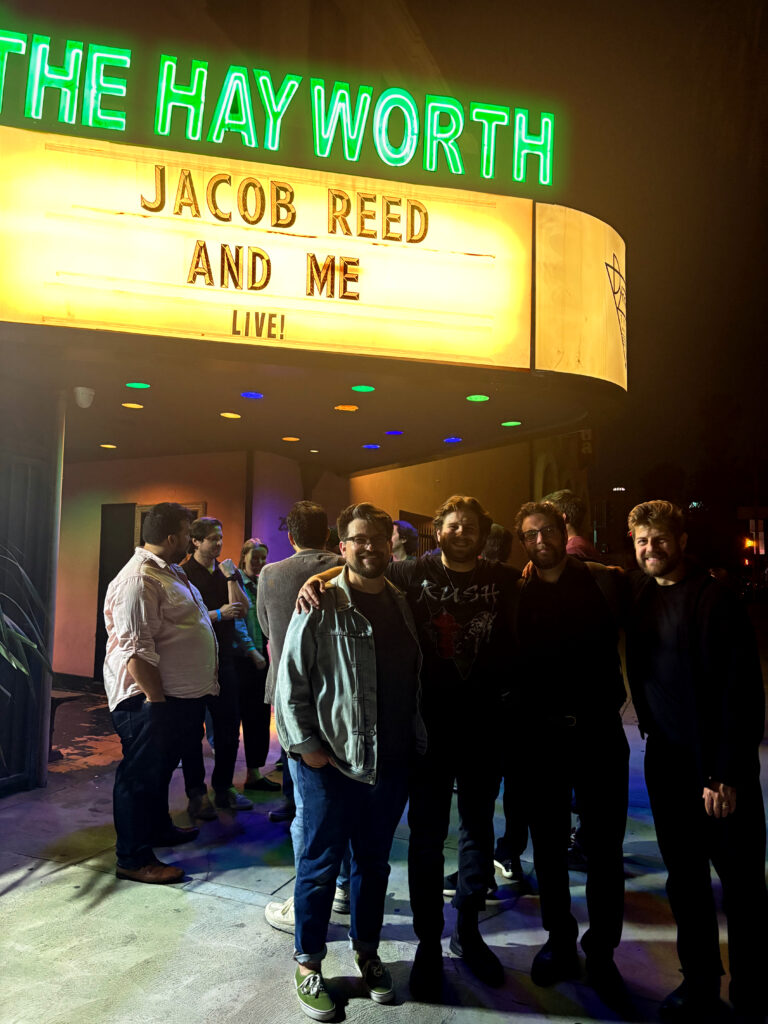
When I got to the venue, the marquee in Big Black Letters was my name, and unlike at the Baked Potato, it wasn’t a coincidence. People were coming to see me.
[MUSIC IN – GONE FLY]
I hadn’t done a live performance since before the pandemic, and for my first live show in six years to have my name literally all over it, seemed like my greatest dream and greatest nightmare was coming true all at once. The whole show was riding on my shoulders, and I was out of practice, under-rehearsed, and on the edge of a nervous breakdown.
[MUSIC OUT]
Jacob: I am so fucking nervous about the piano stuff. I feel like I made a huge mistake.
Dax: And now give it up for the me in Jacob Reed and me Jacob Reed.
When it came to the comedy part of the show, I was in my element. I did a bit with Pasadena drummer Jake Reed where he taught me how to play drums on stage. Matt LeBlanc told me about the time he had to get penis surgery. I got Julia Roberts to go on record about the MCU. We had a magician. There was crowd work. You can see the entire 90 minute show on our Patreon. But it all culminated in the reason we put together a live show in the first place, and the thing I couldn’t avoid any longer: a performance by the Jake Reed Quartet.
Jacob: So I wanna get, drummer Jacob Reed out here. While, drummer Jacob Reed is getting settled, from Columbus, Ohio, drummer, Jacob Reed. And then, Jacob Reed from Baltimore, Maryland.
Holy shit.I couldn’t tell you guys how nervous I am for this part. Oh, fuck. Uh, I’m gonna try, I’m gonna try to play it. Um, yeah. Should we just do it right? I know, I know. Uh,
Baltimore JR: Just stalling.
Jacob: I know. I will stall. I will stall. I, I, uh, am not a musician or a singer. Uh. Okay. Okay. Okay. Okay, okay, okay. Okay. All right. We’re cool. Yeah, yeah, yeah, yeah. Okay.
[LINUS AND LUCY COMES IN]
Things were going well. We were all in sync. And then came the solo. And when the first notes came up, I completely blanked.
[EXTEND PAUSE]
But instead of, but instead of panicking, I remembered what the other Jacobs told me.
Baltimore JR: [FLASHBACK AUDIO] biggest thing is if you fumble something, just keep going
So I kept going.
[JACOB IMPROV SOLO]
I didn’t stop. It felt like maybe the audience didn’t even notice.
[SONG ENDS / APPLAUSE]
I didn’t know if my confidence was up or I was just relieved to have that part over. But then came the other hard part.
Jacob: Okay, so we, we uh, we wrote an original song. Um, should we just do the thing? I’m stalling again? Ah fuck I gotta sing. Okay. Alright, let’s do it.
Jacob: When you’re younger,
parents tell us we’re their special little guy,
a perfect little snowflake
the apple of their eye,
and then you get an email for someone who shares your name
and your uniqueness’ just unique ish. It’s a construct of your brain.
Snowflakes make up blizzards
apple orchards, highly dense
The sheer number of just Jacobs
is a total so immense.
Finding doppelgangers rearrange your self identity?
Just remember there’s nobody quite like me,
Baltimore JR: like me,
Pasadena JR: like me,
Columbus JR: like me.
Jacob: Every quirk has been repeated.
At this point, there was nothing else to do but have fun. The audience was enjoying it, the Jacob Reeds were enjoying it, and it was so infectious that even I was enjoying it.
Jacob: Say hi to the Ohio Jacobs. They both play the drums.
[DRUM SOLOS]
We limited their drum solos to a couple minutes for the sake of an already long show, but as I sat there on the stage, I could have listened to them for so much longer. It’s hard to describe the feeling of watching these three other Jacobs jam together. It seemed so silly, but it also felt like pulling all these weird strings on the internet had actually resulted in building a community.
Jacob: Jacob Reed on the drums again. On the drums that was Jacob Reed. Playing bass, Jacob Reed. And over on the piano, Jacob Reed. I’m the me in the Jacob Reed and Me. Thank you guys so much for coming.
Standing out is overrated.
Uniqueness is a crutch.
The things you think define yourself don’t matter very much.
The only thing that’s special
is the thing you cannot see,
Cause there’s nobody quite like me.
Thank you guys so much for coming.
[FADE OUT W APPLAUSE]
On one of our car rides before the show, Columbus Jacob Reed brought up something called Stretto, a compositional device that Bach used in some of his fugues as they raced toward a big finish.
Columbus JR: I feel like it contributes to the feeling of madness that Fugues have. He’s like one of those mad geniuses that sees all the patterns in a way that I think I will never get to do that. And I suspect most musicians don’t hear or think or see that way. Right? It’s almost like he has a database of all the possible permutations of all the interactions between all the notes at all times. Which is similarly mad to having a database of all the Jacob Reeds.
When I started looking for Jacob Reed the musician, I thought it was because music wasn’t a part of my life, and finding a Jacob in music would help me find my way back. And, in some ways, that was true.
But, I’ve learned that the things music nurtured in me have always been a part of who I am, even if they’ve come and gone, taken different forms, or just been the ingredients that shaped the person I grew into. Maybe this entire podcast is my version of a fugue.
[MUSIC IN – SHOSTAKOVICH FUGUE IN A MAJOR]
Jacob: My name is Jacob Reed.
INSERT REST OF FUGUE
[MUSIC IN – LATE SUMMER LAMENT]
We can’t do it all, so we make choices. We do our best. Things happen to us. The central theme evolves and interweaves with other voices. You take piano lessons, you quit piano lessons, and decades later you destroy a piano and you realize you’ve spent the last five years working on your own contrapuntal, polyphonic, compositional technique where the subject is your own name. And everything else is a variation. And if the melody isn’t what you wanted it to be, you play through the flubs and keep going.
[MUSIC OUT]
[CREDIT MUSIC]
Jacob Reed and Me is a production of Same Name LLC in association with All Trades Co and End of the Road Films. Our executive producers are Danny O’Malley, Alex Rivest, Adam Paul Smith, Chris Kelly, and me, Jacob Reed. Our co-executive producer is Margot Leitman. Today’s episode was produced by Sofi Pascua. Our associate producers are Sophia Lanman and Simone Endress.
The show is written by Margot Leitman, Danny O’Malley, and me, Jacob Reed with additional writing this episode by Sofi Pascua.
This episode was edited and sound designed by Sofi Pascua with additional editing from Danny O’Malley, Jacob Reed, and Will Ryerson It was mixed by Madison Easton.
Our theme song was composed by Daniel Walter with additional music from Epidemic Sound.The original song we did for the show, “Nobody Quite Like Me,” was written by Jacob Reed, composed by Jacob Reed and Jacob Reed. And performed by Jacob Reed, Jacob Reed, Jacob Reed and Jacob Reed.
Our interns are Quinn Jennings, Dylan Keeffe and Sam Walker. Special thanks to our friends and family and to Chris Berube. Mike Leffingwell, Yak Manrique, Matt Mazany, Barry Rothbart, to Marcus Ryle for lending me a keyboard and to the entire staff at Dynasty Typewriter for helping us put on an awesome show.
And to our supporters on Patreon: Doppelganger Detectives, Sarah JB, Laruen W, Madison E, Marcus R, Michelle, R, Willy N, Carole R, Jared K, Eric E, Richard D
and to indie podcast darlings Jerome P, Andrea WC, Doggy Daddy, Carolyn S-R, Edith, Ben R, and Joel,
Get in touch with us at hello@JacobReedAndMe.Com. You can also leave us a voicemail with your “same name” story at www.JacobReedAndMe.com or by calling our same name hotline at 1-94-SAME-NAME.
This podcast was recorded in the Octavia Lab, a DIY makerspace named after celebrated science fiction author Octavia E. Butler, located inside the Los Angeles Public Library’s downtown Central Library. Visit lapl.org/labs to learn more about the free equipment and resources offered at the Octavia Lab. The library does not endorse or oppose the views or topics discussed on this podcast. However, I, Jacob Reed, wholeheartedly endorse the library. Libraries are the coolest… Your move, library. Your move.