[DISCORD VIDEO CONNECTION SOUNDS]
I’m waiting on a Discord video call for someone I’m pretty sure isn’t gonna show their face. In fact, I’m 99% sure I will never see them …. Because this person is trying to scam me. They want me to pay them to write reviews for a book about finances and the economy. A book written by Jacob Reed. There’s just one problem—
[THEME MUSIC STARTS]
–and you probably saw it coming… I’m not the Jacob Reed who wrote the book.
THEME MUSIC AND CLIPS
EMILY BRESTFOD: I’m not here to sell you anything.
STEVEN: Cloodle the grand roodle from the planet zoodle
ECON JR: I’m a little sad this person has my name
SUPPER REVIEWER: Hi Jacob Reed, can you tell us more about you?
HEATHER: you get huffy and puffy
VICTORIA: fake people
SHANE: A bunch of us auditioned, and they picked me.
SUPPER REVIEWER 2: You won’t be able to stay here at all.
ECON JR: In the long run, we’re all dead.
SHANE: I wouldn’t even be surprised, dude, if Jacob Reed wasn’t a real person.
Opening Voices: Welcome to Jacob Reed and Me: a docu-series / a mystery show / a rabbithole / a mundane multiverse / an investigative comedy / that answers life’s biggest questions exclusively by tracking down people named Jacob Reed, hosted by me, Jacob Reed.
Today on the show, Jacob Reed #39: The Economist
[END THEME MUSIC]
ACT 1
Before I get into this, you need to know that not only am I obviously not an economist, I’m very ignorant about the economy.
From my perspective, it feels like the divide between normal people and the super rich has gotten so extreme that whether the economy is doing good or bad, it doesn’t really change my life.
One time I saw this wealth equality chart where people like Jeff Bezos and Elon Musk are on one side, and everybody else—me, the guy who sleeps outside of the Taco Bell near my house, Jennifer Lopez, we’re all basically the same data point by comparison. I graduated college into a recession. I started a family during Covid, and I’ve spent my entire life hearing politicians on all sides talk about how good or bad the economy was doing while nearly everyone I know is struggling to make ends meet… It made me start to wonder: Is the economy just a giant scam?
[MUSIC ENTERS]
Every day, whether it’s on the news or just driving down the street, I see what looks like unchecked greed. And the worst people in the world justify it with the same excuse: “it’s what the market will allow.” It makes me feel like economics is a smokescreen that is used to justify selfish behavior.
And the worst the economy gets, the more I feel like I’m at a disadvantage by not having any idea how to understand it.
But, there’s a Jacob Reed who does understand it. He makes YouTube videos about economics. Almost 200 of them.
ECON JR: Jacob Reed here from review econ.com.
And, he looks cool. I mean, he kind of looks like a skater. He’s got plug earrings and he’s got like a, a trucker hat with graffiti artwork of an equation on it. He kinda strikes me as the epitome of ‘cool teach.’
I first discovered him during the height of the pandemic because he kept releasing these YouTube videos.
ECON JR: Today we’re going to be looking at the macroeconomics graphs that you need to know for your final exam. Head down to the links below. Also, don’t forget to like and subscribe.
It turns out, this Jacob Reed actually is the cool teacher stereotype in his profile picture.
ECON JR: Let’s get into the content.
As I started looking into him, it seemed like he was the guy for AP econ prep. There’s even entire Reddit threads dedicated to his tutorials and explanations. Honestly, it seems like he’s helped a lot of people learn about the economy.
GRACE: Absolutely saved me for my AP exam today,
KYLE: Thanks bro. This is so clutch before my AP macro midterm
TYLER: Yoo, Review Econ is my GOAT.
SARAH: Your videos and website has been a LIFESAVER!!
OWEN: Bro. I’m naming my children after you.
And those comments are from high school students. I’m a middle-aged man. I’ve worked in the economy, I’ve purchased a home. I do my taxes. If a bunch of teenagers can learn about the economy from this guy, surely I can too… right? So I sat down to watch some of Econ Jacob’s videos
[SFX: Click]
ECON JR: Substitutes are goods that can be used interchangeably like honey and jam. Compliments on the other hand, are goods that go alongside each other like jam and peanut butter.
He made clear analogies:
ECON JR: do you need it? If the answer is yes, odds are this product has inelastic demand, like lifesaving medications. If the answer is no, odds are. We have elastic demand like a cookie.
Had catchy and memorable rhymes…
ECON JR: When in doubt. Graph it out.
And, was very encouraging!
ECON JR: We go through it! And if you knew it all, you are on your way to acing your next exam. And if you need help… (fade out)
I gotta say, his videos are pretty well-made. They’re clear, the sound is good, the graphics are helpful. But instead of learning, I found myself getting pissed off and arguing with the videos.
ECON JR: Entrepreneurs take the land, labor capital, mix it all together, take a huge risk and produce a good or service seeking a profit
JACOB: and exploit it. I was not expecting to have such a visceral reaction to just the actual mechanics of how economics is taught and what it is.
ECON JR: We may be looking at individuals who can decide whether or not they’re going to produce lawnmowers. Or, we could be looking at an entire economy that’s producing guns or butter or consumer goods and capital goods. Let’s look at a production possibilities curve.
JACOB: Oooh, well, I hate all of this. It’s basically just how to work within a system that I feel is rigged and prioritizes the wrong thing, which is economic profit instead of actually being able to take care of people.
Who does this jerk think he is, trying to make something so stupid and confusing, seem fun and likable?
I reached out to him through his review Econ website and immediately got a reply. He reminded me that I’d actually reached out to him early on in the pandemic when I first started working on this podcast and saw his videos, and he said, I’m glad to see your idea is getting on its feet. I just took a listen to your first episode and it’s really entertaining and captivating.
Okay, I take it back. I like this guy.
After the break, I meet Econ Jacob Reed.
ACT 2
To learn about the Economy, I’d reached out to AP Economics teacher Jacob Reed.
ECON JACOB: I’m a social science teacher officially. I started teaching economics my first year teaching, in 2003. And, Social science teachers they often tend to be a little afraid of teaching economics as many people are afraid of what the heck economics is all about. So I kind of got dumped in it originally.
Jacob’s being modest. AP classes are certified as Advanced Placement by this thing called The College Board. At the end of the year, students take a test, and if they score high enough, they get college credit for their high school class. It’s a pretty big deal. And It’s common for the best teachers at a high school to be the ones that teach the AP classes. What’s not common is for those teachers to be selected by The College Board as being so good at what they teach that they also are the ones that grade the exams. And Jacob is one of those teachers.
ECON JACOB: I think part of what drew me to it, actually stemmed from when I was in college. I had two professors that were so different. For my first economics class that professor was a libertarian and felt like the government should never get involved in the economy. they’re gonna mess things up and make problems worse. Then I, had a professor that saw government intervention needed everywhere.
ECON JACOB: And what I found the most fascinating is these two guys actually agreed on the primary concepts.
If two experts can agree about the basic facts but come to completely opposite conclusions? How can it mean anything?
JACOB: I know the economy is important. To me it just feels like all, stock market stuff.
ECON JACOB: Right. Right.
JACOB: I think it’s one of those things where like, I’m part of it whether I, wanna be a part of it or not.
ECON JACOB: First of all, to quote Kai Ryssdal. His quote, and it’s my favorite, is: “the stock market is not the economy.” It’s just not. In its essence, economics is about me and you and everybody else in this world and how we function together to get more of what we want.
JACOB: What amount of people do you think do not understand economics at all?
ECON JACOB: I think a huge portion of the population.
So I wasn’t alone. That’s a relief! And, Jacob continued to explain that Economics isn’t as complicated as the huge portion of the population (including me) believe it to be.
ECON JACOB: In the end, the foundation of everything we do in economics, is about choices. And the basic principle is that we can’t get everything we want.
ECON JACOB: We call that scarcity. Human beings want a lot of things. We want more clothing, I would love a Ferrari. But we have to make choices to get what we’re going to get and what we’re not. Those choices are gonna have some costs, economists wanna know, what’s that gonna cost us? And then we can have a true, real conversation about the costs and benefits of things.
JACOB: Well, there is enough for everybody, but some people are hoarding it. So my bullshit meter goes off. And therefore, this whole study of economics is bullshit that finance people tell each other.
ECON JACOB: The fact that not all people in the richest country in the world are having their needs met is what many economists consider a market failure. Economists love markets because they tend to be pretty efficient, but markets also fail. And one of those failures is the crazy unequal distribution of wealth in the United States. So when we talk about scarcity, I’m not saying that if we redistributed all of the food, clothing, and shelter in this world, there wouldn’t be enough to provide it to everybody. What we’re saying is that if that was done, even the wealthiest among us would still want more.
ECON JACOB: Even Elon Musk probably doesn’t have everything he wants. When we say scarcity, everybody has it. The rich people, the poor people, the selfish and the selfless. But economics is trying to help us understand that because we can’t have everything we want we will have to make choices.
[MUSIC ENTERS]
That kind of blew my mind. Cause, I think of scarcity as my wife and I trying to balance which bills we’re paying; or whether or not we can take a vacation, if we can afford to have a babysitter so we can have a date night, or have our kids in after school programs. if economists are viewing scarcity as this shared experience for every person on the planet—including the obscenely wealthy—that’s a totally different definition.
JACOB: It’s almost like my, my perception of economics is it’s a science created by people who already believe a certain thing.
ECON JACOB: Yeah.
JACOB: Not that it’s based on, reality. Like in communist countries, do they study economics?
ECON JACOB: Yeah. Karl Marx was an economist of sorts,
Alright I walked right into that one.
ECON JACOB: It’s a social science. We use scientific methods, we do scientific research, but people are hard to understand and we’re trying to understand human behavior and massive groups of people.
JACOB: Okay, so I’m just thinking like, take two extremely polarizing political figures, right? Right now, despite everything that I can see to the contrary, Donald Trump is telling everyone that the economy is doing fantastic. Before the election, Joe Biden was telling everyone that the economy was doing fantastic. I support and supported the majority of what Biden did, but I would get these fundraising emails from his team saying we’ve created three times the jobs of this and that, and, I would look at those be like, okay, you created three times the jobs, but everyone I know has to have three jobs to get by.
ECON JACOB: Right.
JACOB: So is that really creating three times the number of jobs, or did you just take what should be one job and split it into three?
ECON JACOB: I also think this aggregate data, the massive data for the entire economy leads to a lot of the frustrations you’re talking about right now. The unemployment rate was relatively low at the end of the Biden administration. But, people don’t always understand what the unemployment rate truly measures. And then when we talk about wages are rising faster than unemployment, well, I mean that’s on average, but, who’s the average? The average person doesn’t potentially even exist, you know?
So, when we hear about the economy in the news, it’s aggregate data. This means the data is pooled from all over a massive system. And sometimes important things are lost in the details. It’s like squinting at the economy, and pretending that the blur is the picture. Maybe that’s why I feel lied to when I hear people say, “the economy is doing great.”
JACOB: For someone like me do you think that if I understood how the economy worked better, I would be less mad about it?
ECON JACOB: Ehh… honestly, I don’t believe you’d be any less mad, no. No. You’d understand it more. You might have more tools.
JACOB: So then why should anyone understand it?
ECON JACOB: Politicians are constantly telling us they’re just gonna give us things, but understanding what the incentives are, how does that actually change our behavior potentially? Like, for example, the no tax on tips thing. A lot of people who earn tips are low income and hey, giving them a tax break is a great idea. But is that how we want to do it? Or, are we saying no tax on tips because Las Vegas has a lot of tips and Nevada is important to the political win? Or, are we trying to help the poor? And if we’re trying to help the poor is that how we want to do it?
JACOB: You’re saying, if that’s the case I should understand the economy because it, will…
ECON JACOB: Make you a better voter and make you a more engaged citizen. And I think it will help you understand when politicians are bullshitting us.
[MUSIC ENTERS]
I had so many more questions I wanted to ask, but we ran out of time. Talking to Jacob made me wonder… Am I alone in this. Do other people I know KNOW about the economy and they just don’t talk about it, or is it just a mystery to me? So the next time I was hanging out with some friends, I brought up the economy over a couple of beers.
JACOB: These are good.
DANNY: I don’t know where this one’s from
JACOB: Are there any more lime wedges (fade out)
I was sitting around a fire pit in our backyard with show producer Danny, my wife Heather, and my friend Ky. Not Kai Ryssdal.
JACOB: Like when people say, the economy’s good, the economy’s bad. Do you feel like, oh, I understand what that means?
KY: Well, there’s two basic spheres of economic theory. Microeconomics and macroeconomics, and they both talk about different interactions of human behavior when it refers to money and spending and the allocation of resources to different things.
VO: Okay…. So Ky definitely knows about the economy.
JACOB: Well, I understand something like supply and demand is a basic economics thing, right? If you decrease supply, you’ll increase demand and you can make money.
DANNY: I don’t think that’s right.
JACOB: What’s right? What I’m saying about supply and demand?
DANNY: If you decrease supply you don’t necessarily increase demand, you increase prices
JACOB: That shows you how little I know. Okay, so then maybe not supply and demand, but like scarcity. If you talk about demand–
KY: that’s same thing.
So, I may have been a little over my head, but that didn’t stop me from trying to make a point.
JACOB: My response to something like scarcity is, what is it and is it really scarce? Are you saying that water is scarce? But that’s because some assholes, like Arrowhead have bought up all of the reservoirs in California? I guess my thought is like we teach our kids about sharing, right? But when you’re a grownup, we study economics and if we were teaching our kids economics. It would be like instead of teaching our kids to share, we’re teaching them that not everybody can have everything,
KY: Or you’re teaching your kids to find something that you can get a lot of and then figure out who wants it,
JACOB: Right.
KY: And squeeze as much money out of them as possible.
JACOB: Right. Like wouldn’t that be a shitty way to raise kids?
DANNY: There’s a housing crisis in California.
JACOB: Okay.
DANNY: What is your opinion on rent control? Is it good or bad?
JACOB: I think it’s good.
DANNY: Why is it good?
JACOB: Because if there’s rent control, then people can afford to stay in their houses. For me, I look at like, who’s getting screwed? Who’s getting screwed by there being no rent control, people who don’t own a lot of property, who most likely are trapped in a lower socioeconomic bracket The downside to having rent control is people who already have properties that exist only for them to make money off of other people… They don’t get to make as much money as easily. And that—
DANNY: Not the only downside.
JACOB: What other downsides are there?
DANNY: There’s a lot of people who would love to buy up houses that house one family and put up big chunky things that house four or six or eight. And that can’t happen because there are people who are incentivized to hold onto their rent.
JACOB: But, it’s–
DANNY: So the short term benefit to that person adds up to a long-term problem that affects everybody,
JACOB: Which is a bigger, impediment to someone who’s trying to buy up single family homes and turn them into multi-family units? Is it, our old neighbors, who lived in rent controlled apartments. Or is it huge private equity firms buying up entire neighborhoods to list on Airbnb. Like, which is the bigger problem?
I’ve known Danny for two decades and we agree on most things politically, but he asked me a simple question and I’m talking paragraphs at him like I’m trying to win an argument he’s not even having.
JACOB: My issue is so quickly, once you involve the economics of it all the conversation goes to like, well, here’s why it’s actually a problem for this family just trying to make ends, meets to live in their house. Why isn’t the first thing we all say like, Hmm, maybe it’s bad if a company is buying up whole neighborhoods.
HEATHER: You’re bringing the social aspect into economic, like, I, I think that’s maybe a problem for you is because economics… it’s just the numbers.
JACOB: But not just the numbers. Math is just the numbers.
KY: That’s what economics would argue though, is that it boils down to numbers.
HEATHER: Yes.
JACOB: But it boils down to numbers in a system where becoming profitable is the only goal.
KY: And I would argue that’s the problem with capitalism is that it boils down to just the numbers and it doesn’t account for the social aspect, which I think is more important.
JACOB: So what you’re saying is my beef with economics –
KY: Is capitalism.
JACOB: might actually a beef with capitalism
KY: Yes.
HEATHER: I think that’s maybe your key misunderstanding about economics it’s not just about who has money and who doesn’t have money. You assign value to everything, And you get huffy and puffy and it clouds your ability to see things objectively.
Alright, maybe my wife is right. ‘Cause, Every opinion I have about the economy is squeezed through this emotional filter and it comes out so charged I can’t even have a calm conversation with my wife and friends about it.
I decided to back up and ask them what things they would want to know.
JACOB: What would you want me to know? From a Jacob Reed you didn’t marry, who’s smarter about the economy.
HEATHER: I wanna know what it would look like if California. One of the largest economies broke off and was its own. No, I wanna know.
JACOB: No. No.
KY: That’s a good question
JACOB: I that’s the the wrong question, what I think is a better question is what kind of power over the rest of the US economy can California leverage?
HEATHER: Sure.
JACOB: One example of that that I like to tell people is Prop 65. Basically it was a law that if there’s a chemical that could kill you in something, you have to let people know. And so at that time there were chemicals that could kill us in almost all of the snack food that was made.
JACOB: California passed that law saying “Hey, you actually can’t have, like formaldehyde in Doritos.”
JACOB: This was not a law that affected the rest of the country or the rest of the world. But because California was a big enough market, all of these, manufacturers make one product for everyone, but make it safe to California’s standards
HEATHER: I think you know more about economics than you think you do because you know a lot about politics and they’re very intertwined.
HEATHER: On its own, you know, the supply curve, whatever. You wouldn’t know shit about it, but if it was applied in a topic you care about you just haven’t identified it as economics.
Maybe I… do know something about the economy?
KY: the US dollar is, the, reserve currency, for many countries. The US still has international power is because our economy writ large is big and the US dollar is still highly valued, but that has been changing progressively over the last 30 plus years.
No. I don’t know anything about the economy. But, it did feel good to talk to other people about it instead of just shutting down when it comes up. And I learned that even the people I know who know more about it than I do, still have a lot of questions. Best of all, I had some clear things to talk about next time I got on the phone with Jacob Reed.
JACOB: I think I’ll, start with this because it’s at the root of all of my other questions.
ECON JR: Okay.
JACOB: If we’re only focused on that bottom line, what else is being lost and how do we incentivize things that can’t make a profit? A classic version of this is a tree, it gives us shade, it gives animals and plant life this whole ecosystem, it literally helps us breathe air. But in the economy that we live in, its value is X units of lumber. And if it cannot produce that, it has no value.
ECON JR: And a lot of economists are very concerned about those sorts of things. Things we value but can’t be quantified in dollars and cents. A lot of economists are trying to figure out how to quantify these non dollars and cents values.
Alright, THIS is the kind of economics I’m excited about. I wanna know What we can do to course correct our money-hungry consumerist society, and steer the ship away from the iceberg.
ECON JR: But the fact is, that tree does have value as lumber. My house is made outta lumber. The, classroom I’m sitting in right now is made outta lumber. But there’s also a cost to cutting down that tree, and part of the cost is paid by the company that chops the tree down.
JACOB: Like you’re literally talking about the labor the transport, the gas.
ECON JR: Exactly, but as you point out, there are benefits to trees outside of building houses, and there are costs of removing those trees outside of chopping them down. In economics, we call these market failures.
That’s not a “market failure,” that is a stupid and broken system.
ECON JR: My point is a lot of people are under the impression that economists always love markets and think they’re perfect.
JACOB: Yes. That’s how I feel.
ECON JR: And, they’re not. There are positive externalities and there are negative externalities. And these are when there are benefits or costs that fall on people not involved in the transaction. The most classic example of an externality is maybe a, factory just dumping the waste into the river. Clearly that’s going to be bad for people down river, so that is a negative externality and a huge problem. Because the market is creating bad outcomes.
ECON JR: That’s where a lot of people have problems with the economy, but I don’t think the problems stem from economics. And in fact, I think that economists expose these problems and come up with potential solutions to these problems.
JACOB: Are you saying they’re good? The economists are actually good?
ECON JR: Well, some are, for example you had a question about the growing wealth and income gap. We have this way of measuring it. It’s called the GINI Index. This index shows that, no surprise, the, income inequality in the United States has been growing significantly since the eighties. We wouldn’t know to what extent if it wasn’t for economists having a way of measuring it and then a way of showing it.
JACOB: Economists are almost like meteorologists or something, right? But they’re not Storm from the X-Men actually making weather systems happen.
ECON JR: There are a lot of economists who are focused on their beliefs and, I think that’s a big aspect of people’s disdain for economics. But that in and of itself is not economics.
So, maybe economics isn’t the villain. The villain is individual players who manipulate the market to achieve their own goals. And, If this system can be swayed toward the dark side, maybe there’s a way of swaying it toward the light?
ECON JR: The famous quote by John Maynard Keynes, he’s known as the father of macroeconomics, he said, in the long run, we’re all dead. He was acknowledging, yeah, in the long run, the economy will fix itself, but, it might take way too long. And in the long run, we’re all dead.
Jacob was working his magic on me. It honestly hadn’t occurred to me that economics could be used for good. But… After this conversation, I got a strange email.
[EMAIL INBOX NOISE]
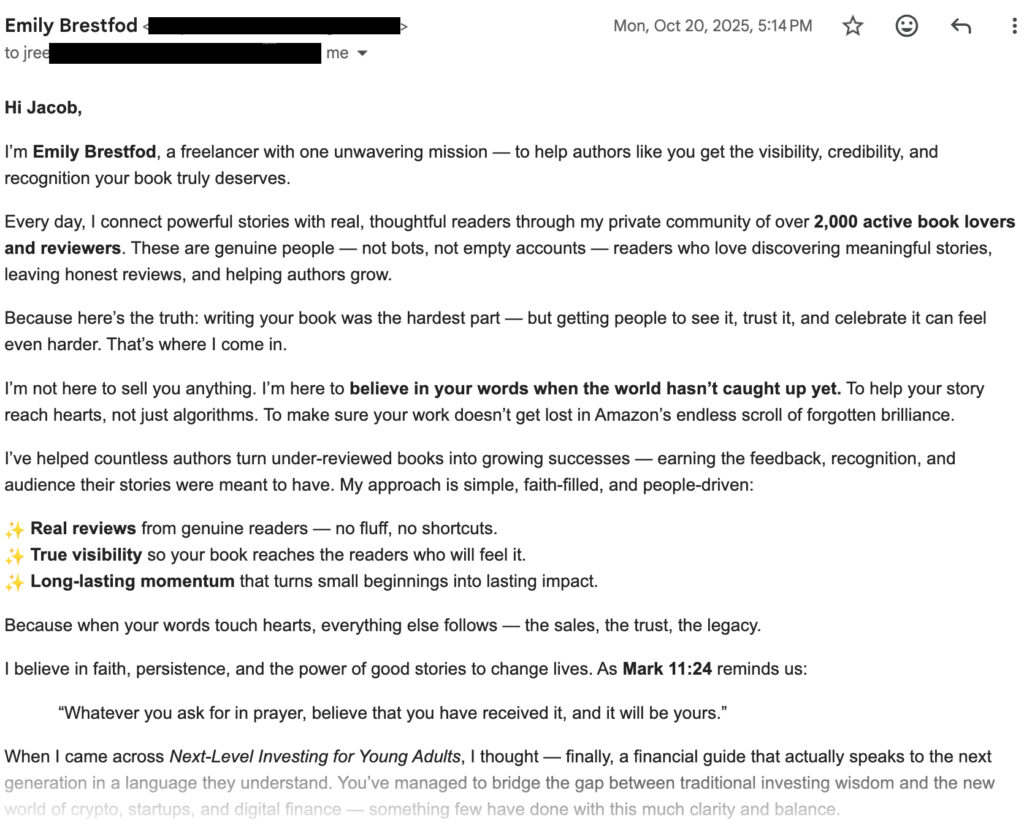
EMILY BRESTFOD: Hi Jacob, I’m Emily Brestfod, a freelancer with one unwavering mission to help authors like you get the visibility, credibility, and recognition your book truly deserves.
The email was sent to five Jacob Reeds. My current email, two old work emails, and two Jacob Reeds I’d never heard of. I reached out to both, but, I got bounce backs.
EMILY BRESTFOD: I’m not here to sell you anything.
JACOB: I highly doubt that.
EMILY BRESTFOD: I’m here to believe in your words when the world hasn’t caught up yet, and to help your story reach hearts, not just algorithms, to make sure your work doesn’t get lost in Amazon’s endless scroll of forgotten brilliance.
EMILY BRESTFOD: Your book doesn’t just teach wealth-building — it empowers it.
In case it’s not clear, I have never written a book. Actually, that’s not technically true. I am the co-author of a book of 50 movie-themed crossword puzzles for seniors – which is a long story, it’s not relevant here… but I haven’t written any other books.
EMILY BRESTFOD: It’s more than a guide, Jacob. It’s a mindset shift toward independence, responsibility, and Generational success. When I came across Next-Level Investing for Young Adults,
Okay, there’s the title of the book…
EMILY BRESTFOD: I thought finally, a financial guide that actually speaks to the next generation in a language they understand.
So, I’m in the middle of learning economics, from a Jacob Reed who teaches young people and somebody emails me about an economics book that a Jacob Reed wrote for young people.. It can’t be him, right? Is this a prank?
After the break, I follow the money down an economic rabbit hole…
ACT 3
I was a few months into watching Econ Jacob’s videos, reading books he suggested to me, and having weekly conversations with him when I got a bizarre email from a woman named Emily Brestfod offering to get reviews for a book she thought I wrote about finances and economics.
[MUSIC BEGINS]
I’d gotten to know Econ Jacob pretty well at this point and I didn’t think he would write a book like this. So, of course the next thing I did was look up the book I supposedly wrote about finances and economics.
[keyboard clicking SFX]
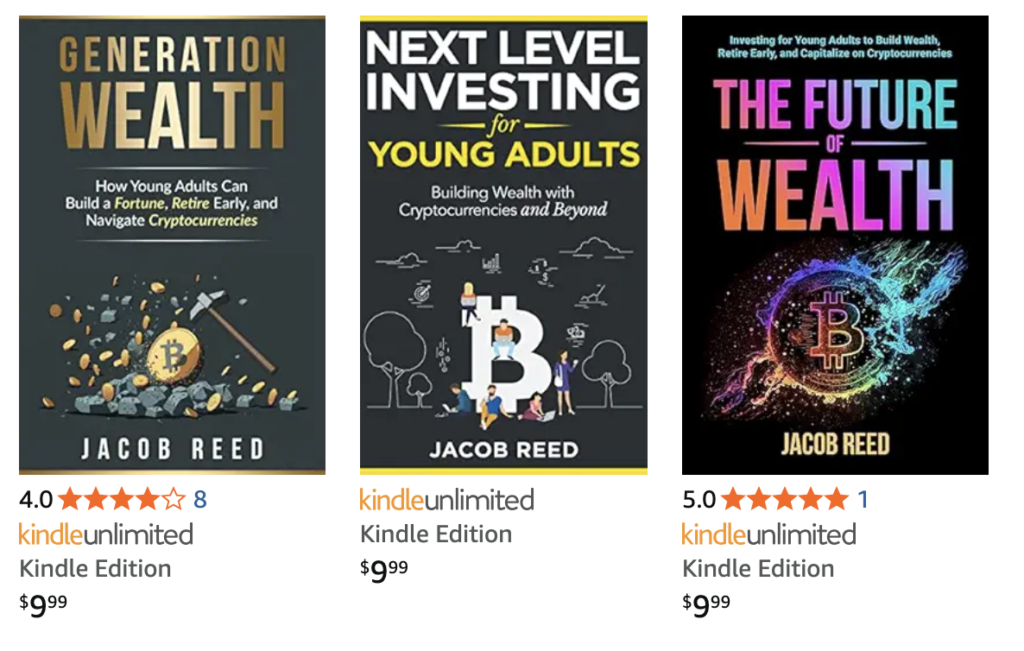
Next Level Investing For Young Adults is actually… part of a trilogy. There are three books, all written by Jacob Reed.
Next-Level Investing for Young Adults: Building Wealth with Cryptocurrencies and Beyond
Generation Wealth: How Young Adults Can Build a Fortune, Retire Early, and Navigate Cryptocurrencies
and, The Future of Wealth: Investing for Young Adults to Build Wealth, Retire Early, and Capitalize on Cryptocurrencies.
Weirdly, they each came out a month apart in the summer of 2023. They’re all almost exactly the same length, and they’re all very crypto focused.
But the weirdest thing about these books is the Jacob Reed who wrote them didn’t seem to exist.
[MUSIC CHANGES]
Despite the book billing him as an “author and financial planner”, he had no social media. No author page. No website. In fact, nothing was available about the books online outside of Amazon and Audible. I guess that’s why Emily Brestfod reached out to me….
I wanted to talk to Econ Jacob about these books, but first I needed more information about them. So I decided to listen to Crypto Jacob’s books.
[MUSIC ENTERS]
AUDIOBOOK NARRATOR LAYNE: I got my first taste of working in corporate America as soon as I graduated from college. I was a hopeful young adult ready to take on the world and carve out my own path to success.
I noticed they didn’t have a single specific detail about Jacob’s life.
AUDIOBOOK NARRATOR LAYNE: I approached my sales representative job with passion
AUDIOBOOK NARRATOR LAYNE: after 15 years of working in the same job, realized that I was financially stagnant throughout my career.
AUDIOBOOK NARRATOR LAYNE: When I left the corporate industry to start my own business,
What kind of sales rep job? What was the business you started? Like, give me anything. The lack of specifics, repetitive advice, the grammar, it really felt like AI. So, I copied the text of all three books into a tool that checks to see if things are written by AI, and it suggested they were likely 85-90% AI generated at a minimum.
[MUSIC CRESCENDOS OR CUTS OUT WITH TRAILING ECHO]
As I was looking over the results, I realized there’s patterns to AI writing that I had never even noticed. One of the things it noted was frequent transitional cliches:
AUDIOBOOK NARRATOR ADAM: In a nutshell,
AUDIOBOOK NARRATOR ADAM: in a nutshell,
AUDIOBOOK NARRATOR ADAM: In a nutshell,
Another was the repetition of key phrases from systems trained on self-help and investment texts.
AUDIOBOOK NARRATOR LAYNE: Financial literacy is the first step on the path to financial freedom,
AUDIOBOOK NARRATOR SHANE: Road to financial freedom.
AUDIOBOOK NARRATOR LAYNE: Journey to financial freedom.
AUDIOBOOK NARRATOR ADAM: Financial freedom
AUDIOBOOK NARRATOR SHANE: financial freedom
AUDIOBOOK NARRATOR LAYNE: and flourish into flowers of financial freedom.
Apparently it was also a sign of AI writing to list the number of ideas that are about to be presented…
AUDIOBOOK NARRATOR SHANE: there are several methods.
AUDIOBOOK NARRATOR ADAM: Six major asset classes,
AUDIOBOOK NARRATOR SHANE: five layered protocols,
AUDIOBOOK NARRATOR LAYNE: Four main types
AUDIOBOOK NARRATOR SHANE: three main ways
AUDIOBOOK NARRATOR ADAM: two major ways
And a partridge in a pear tree…
[MUSIC COMES BACK IN]
The “is this AI” analysis further cited the flat, idiosyncratic voice, the ‘encyclopedic breadth but shallow depth’ and explanations that rephrase familiar web-level investment advice without introducing an author-specific story. While they stopped short of determining the books were plagiarized, it did say that their “comprehensive and generic coverage” echoed the tone of “content-farm financial literacy ebooks.”
But besides being clearly written by AI, this also didn’t seem like Econ Jacob’s bag. Because, the whole “wealth mindset” undertones were the opposite of the pragmatism and real talk that I liked about him. I showed him the books.
[MUSIC OUT]
ECON JR: Oh, oh, it’s by Jacob Reed, it says. Interesting. I’m assuming that it’s not you.
JACOB: I’m assuming it’s not you.
ECON JR: It’s not me. In fact, I’m a little sad that this person has my name on their books. Who the heck is this Jacob Reed?
I told Jacob I’d find out. I’d already listened to 9 hours of crypto fluffing across all three books and not gotten a single clue about who Jacob was, but I listened again. This time, all the way through to the credits of all three books – and finally, in the end credits for the third book, I found this:
AUDIOBOOK NARRATOR SHANE: this has been Generation Wealth, how young adults Can Build a Fortune, retire early, and Navigate Cryptocurrencies. Written by Jacob Reed, narrated by Shane Matsumoto, Production copyright by Scott Gavlick.
Who the hell is Scott Gavlick??
[MUSIC IN]
I looked him up and found one person by that name. I sent him an email, I DMed all of his sparse social profiles, but I got no reply. Eventually I looked him up in the phone book, where I found thirteen phone numbers that had been associated with a Scott Gavlick over time.
AUTOMATED VOICES: We’re sorry you have reached the number that has been disconnected // or is no longer in service. //If you feel you have reached this recording in error, //Please check the number and // try again later.
As I’ve been working on this podcast, I’ve cold called a lot of people whose numbers I find on the internet. Most of the time, you get a wrong number, maybe one or two disconnected lines. For Scott, there were a record 13 disconnected lines. Was it a coincidence? A mistake? Or someone covering their tracks?
I didn’t know. But since I couldn’t find Scott, I decided to reach out to someone who almost certainly would have met him.
[DIAL TRILLING]
AUDIOBOOK NARRATOR SHANE: This is Shane.
Shane Matsumoto narrated one of the Jacob Reed crypto books. And he’s narrated dozens of audiobooks.
AUDIOBOOK NARRATOR SHANE: Yes, fiction, nonfiction. Even, even an erotic title or two.
But when I asked him about crypto Jacob Reed, he explained the whole job was done through something called Amazon ACX – a marketplace that connects publishers directly with audiobook narrators.
AUDIOBOOK NARRATOR SHANE: A bunch of us auditioned and they picked me. I didn’t have any personal contact with him. I probably never talked to him on the phone or personally didn’t have never met him.
JACOB: there was another name I wanted to ask you about the production copyright, uh, is by a guy named Scott Gavlick, and I was wondering if that sounded familiar at all.
AUDIOBOOK NARRATOR SHANE: Not at all.
AUDIOBOOK NARRATOR SHANE: If this was one of the ones that were by ai, I’ll tell you, they do a lot of just totally made up names too. Like I wouldn’t even be surprised, dude, if Jacob Reed wasn’t a real person.
[hang for music / impact]
Wow, two episodes into a podcast about finding people with my same name. It seemed like I was getting more fake Jacob Reeds than real ones.
Oh — and after we talked, Shane emailed me because he remembered the first draft he narrated was full of weird grammar, repetitions, and typos. So, he emailed Scott to ask if there was another version, and never got a reply. To make sure he hit the deadline, he read the book verbatim — typos and all — assuming that he’d get notes to fix things. Instead, the audio was immediately approved, as if nobody had even listened to it.
[MUSIC ENTERS]
After hitting dead ends with Scott and Shane, I thought maybe I could get some more info from the person who emailed me about the book: Emily Brestfod. I asked her if she had any info about its origins:
[SFX EMAIL ALERT]
EMILY BRESTFOD: I came across your book on Amazon. Now, if you don’t mind me asking you question, would you be open in hearing about something that could truly make a difference for your life and your book either? Question mark? Second question mark?
That didn’t answer my question. So, I didn’t respond. But, a few days later she followed up.
[SFX EMAIL ALERT]
EMILY BRESTFOD: How have your days been going over there? How’s the family and business coming along?
I’d told her about neither my family or business.
EMILY BRESTFOD: I just wanted to follow up on my last message and thank you again for your openness. It truly means a lot.
Prayer hand emoji.
EMILY BRESTFOD: So, would you like to cooperate, participate, and move forward kindly with me?
It was clear I wasn’t going to get any additional information without engaging in Emily’s offer… so, I took the bait and replied “yes.” Emily Brestfod explained that she runs a community of 2,000 readers and that she could help me get reviews “naturally and ethically.” I asked if I could interview her, but Emily told me everything is done through their private discord server – a “vibrant community for authors and readers to share their love of books.” So, I joined…
EDWARD: Welcome Jacob Reed
ELIZABETH: Hi Jacob Reed, can you tell us more about you?
JOSHUA: What inspired you to start writing your latest book?
JUDITH: Are you a bit excited and have great expectations for your book in this Q4 season?
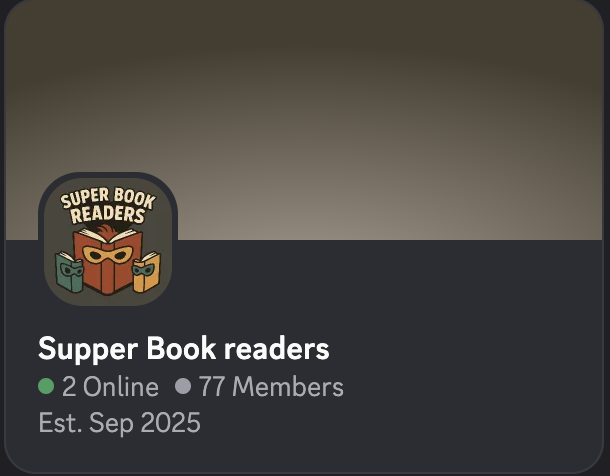
The channel icon was an AI illustration of books wearing super hero masks and the text “Super Book Readers” — like you know people who are reading heroes — but everywhere else, it was spelled with two Ps, “Supper Book Readers” — like people who read books about dinner. I scrolled to the beginning of the server and read through all of the messages and I discovered a cycle:
Somebody new would join, half a dozen members would ask them questions, “what’s your book about?”, “how did you get into writing?”, “what are you reading?”, etc. The new person would then ask either skeptical questions, and eventually leave, or they would pour their hearts out to the other “members”, then be referred back to the email from Emily, or whoever their handler was.
I ended up lurking in this discord server for several months. During that time, I noticed many of the “members” changing their name and profile pictures every few weeks, shedding their avatars and becoming completely different people.
There’s a scene in one of my favorite movies, The Sting, where Robert Redford and Paul Newman stage a fake betting parlor to con a wealthy mobster.
It’s a trope of the con genre. At a glance, when emotions are running high, it seems totally legit.
CLIP FROM THE STING: We’re waiting on [unintelligible] I’ll call Belmont next…
But… If anyone pays attention for more than a moment, it’s an obvious facade.
CLIP FROM THE STING: That’s it fellas! [laughter / breaking character]
That’s what the Supper Book Readers’ Discord was.
I asked a lot of naive questions: who were the people here? How did they find the server? Had they gotten supper great reviews from any of the supper heroes?
JUDITH: yes we are readers , we love to read books and leave honest opinions that could help books get visible and live.
JOSHUA: your book just sit there buried under the dust of amazon , definetly having sales or getting visibility will be very difficult or almost imposible .
ELIZABETH: We are all a real person , normal people out there, everyday workers.
But if I ever asked something like “how do we know this isn’t a scam?” The friendliness disappeared.
EDWARD: We are not a scam and will definitely not tolerate that accusation
ELIZABETH: You can’t just accused people randomly
JOSHUA: you won’t be able to stay here at all
I think Emily Breastfod must have gotten in trouble for my question, because the next day she sent me a message:
[DM SFX]
EMILY BRESTFOD: please avoid going into the group to ask frustrated questions.
EMILY BRESTFOD: If you need anything, ask me directly.
So, I told her my concerns directly… and she replied.
EMILY BRESTFOD: I hope you were getting me too much problem and I think I will not be able to move forward with impotent like you no more. As regards to this no more conversation either with me or in the group or else you will be blocked, delete and removed away. Exclamation mark. Exclamation mark. Exclamation mark!
Wow. I felt kinda bad. I mean, I didn’t want to get scammed, but, I wasn’t trying to get Emily Breastfod fired from her scamming job. I decided to stop replying and stop looking into Supper Book Club at all. But, a few days after I had weaned myself from looking into her, Miss Breastfod reinitiated the conversation.
EMILY BRESTFOD: Honestly, I feel like there’s still a little trust issue between us — and I get it, but let me be real with you for a second. We keep things simple, human, and low-drama. We don’t do calls. Not with anyone.
EMILY BRESTFOD: Here’s what I can do, and honestly, this is probably the most transparent thing possible:
EMILY BRESTFOD: I can send you the contact details of authors who’ve done this before, so you can talk to them yourself. You can Google them, check their Amazon pages, see their books, whatever you want. No mystery, no smoke, no mirrors.
Yes, I obviously want to talk to other authors.
[MUSIC ENTERS]
One of the emails Emily Breastfod gave me was for a sci-fi author named Steven Joseph. I exchanged a few emails with what was pretty clearly a fake version of Steven Joseph who knew about his books, but also was overeager to talk about how great Supper Book Club was. Then, I tracked down the Real Steven Joseph.
STEVEN JOSEPH: I hope they said good things.
Steven told me he gets a lot of emails from people who are seeing if he’d vouch for these scammers.
STEVEN JOSEPH: You’re like the fifth person. Usually it’s through Instagram. They reach out to me and they want to know. Hey, how is this person? It’s always a different service provider or scammer but it’s always the same email. My name was given as a reference. It’s an easy name. I have a bunch of reviews on Amazon. ‘Oh yeah. He has reviews on Amazon’, So they might think that this scammer has something to do with it.
Real Steven has had moderate success with his books, which places him at the right level of exposure for the scammers to impersonate. He’s sold enough books to claim they helped add to his success, but obscure enough that people wouldn’t know if they were talking to him or an imposter.
STEVEN JOSEPH: With ai, they get better and better like they get into the details about my book.
And Steven’s Sci-Fi books take place in a very specific world.
STEVEN JOSEPH: Cloodle the Grand Roodle from the planet Zoodle is sort of a villain in Noodle Ham. And, the biggest act was Swifty Swoodle and Doo-wop-a-doodles. He goes back to Zoodle disgraced, and then he kidnaps, Schmoodle the poodle and Droodle the poodle and sends them to Zoodletraz.
Since the scammers already knew about Cloodle the Grand Roodle, the planet Zoodle, Swifty Swoodle, Doo-wop-a-doodle, Schmoodle the poodle, Droodle the poodle, and Zoodletraz, I was gonna have to ask them about something that only Steven knew:
JACOB: They said that your favorite book is The Alchemist by Paolo Coelho Ho.
STEVEN JOSEPH: If it’s a good book, I should read it, but, I’m a Harry Potter guy.
JACOB: They also said your favorite ice cream flavor is vanilla.
STEVEN JOSEPH: No. I like pistachio.
When I challenged Emily on the legitimacy of these author emails, she gave me the email address of her supervisor.
EMILY BRESTFOD: I can connect you directly to the group manager for a quick 2–3 minute voice chat, just so you can feel completely at ease before we continue.
[SFX: DISCORD VIDEO WAITING AND PICK UP]
JACOB: Hello?
KING SHADOW: Hello.
JACOB: Hi. Can you hear me?
[MOANS IN BACKGROUND, THROUGHOUT]
KING SHADOW: Hi Jacob. How you doing?
JACOB: I’m doing good. What should I call you?
KING SHADOW: My name is just King Shadow.
JACOB: Your, your name is King– Your parents named you King Shadow?
KING SHADOW: Unintelligible
JACOB: That’s umm.. Uh…
KING SHADOW: Unintelligible
JACOB: Huh?
KING SHADOW: What do you see?
JACOB: What do I see? I cannot see you. I just, I hear someone moaning in the background and I, I don’t see you.
KING SHADOW: Oh, it’s a connection of course.
JACOB: Do you wanna turn your video on?
[SFX: Discord disconnect noise]
JACOB: King Shadow has left the meeting. So much for three minutes.
I must have crossed a line, because over the next few days I got dozens of emails from dozens of different book review communities. King Shadow had declared it open season on me.
EDWARD: I stumbled across your book and it literally stared at me like it was saying, “Please, for the love of all plot twists, get me out of Goodreads invisibility.”
ELIZABETH: Your book deserves readers who debate strategies at 2 a.m., not a polite scroll and a “nice” emoji.
JOSHUA: I support authors by helping their books gain more visibility.
VALERIE: I’m part of Private Community Readers, a private circle of 3000 plus passionate readers.
JUDITH: If you’d like me to get started, just let me know. I can begin immediately once you confirm.
I had stumbled into such a strange nook of the publishing world full of scams and shadowy (or King shadowy) figures. It turns out this is a pretty common scam.
VICTORIA: Really what has turbocharged, all of this is the rise of the self-publishing industry.
That’s Victoria Strauss. She runs a website called Writer Beware, where she debunks scams that target writers.
VICTORIA: Self-published authors need more services than traditionally published authors do. And competition for sales and visibility is a huge opening for scammers.
The recent explosion of self publishing accelerated by Kindle and Audible, has created millions of isolated authors who have to handle editing, marketing, and promotion all on their own. Combine that with advances in AI that make it easy to handle a large volume of responses, and you create a fertile landscape for a brand new Internet scam.
VICTORIA: This really only began to appear late spring and early summer of this year. I mean, this tip reviewer scam literally did not exist before this year. The claim is that there’s a community of 2000 eager readers. You give them a tip of 20 bucks. And they will read your book and review it. The reality is that this is all driven by generative ai. There are no readers, Sometimes there are these private Discord communities…
Like Supper Book Readers.
VICTORIA: They’re administered by whoever the scammer is and they’re populated by fake people. You never actually get any reviews. Or you might get one or two, but you’re not going to get 30 or 40 or whatever it is that you bought.
Or, in economic terms:
[MUSIC ENTERS]
Amazon’s marketplace exploits the increasing number of self-published authors in order to provide high volume at low cost. They use capital-labor substitution, replacing human curators with an algorithm to maximize profits. This causes a negative externality: authors can only get attention by gaming the review algorithm. Because buyers lack good information and sellers can make hard-to-verify claims, it results in information asymmetry which becomes a market failure where scammers can easily take advantage of hopeful authors….
[END MUSIC]
ECON JR: I am so proud.
I was filling Jacob in on everything I learned about the crypto books.
ECON JR: This is so great. This is so great. Yes. You got barriers to entry, you got market failures. You’re talking about negative externalities and asymmetric information. Man, this is great. Yes.
JACOB: And I understand what I just said–
ECON JR: Yeah, yeah.
JACOB: –and I, wouldn’t have, three months ago. I did not think it was possible for me to learn this much in this amount of time.
ECON JR: Yeah. And what’s interesting about this is the profit’s going to eventually go away because more and more people are gonna be trying to game the algorithm. And the consumer’s just stuck with a bunch of AI slop.
JACOB: The fact that you could fully write a book with AI, put it up on Amazon, put a fake name as the author, and nobody would necessarily know the difference… At the very least, feels irresponsible And so that to me would be maybe another, I guess I’m just using the word market failure to say anything that I think is bad now, I’m just calling a market failure.
ECON JR: It’s definitely a market failure.
JACOB: The fact that people can write seemingly fake reviews for this seemingly fake book written by this seemingly fake Jacob Reed and all of those people make money by doing something that is not adding anything.
ECON JR: There is a significant problem with Amazon’s regulating of their own marketplace. I have bought things where I later go, “Oh. Wha–this is terrible.” And then I go and look at the reviews, and the reviews are all five stars. But then I go, “Wait a second! This is for a grill! I didn’t buy a grill. I bought a windshield crack fixer.”
JACOB: Right.
ECON JR: Th-that’s why it’s crap.
JACOB: Right.
ECON JR: because they changed the product.
ECON JR: On the bright side, Amazon does give you your money back. That terrible windshield crack fixer, they did make it right. But I was also really annoyed and pissed off because I’m the person that’s gonna send it back because it’s principle. I mean, the thing only ended up costing like 10 bucks, and it would probably cost me more than $10 worth of my time to repackage it and go all the way to the UPS store. But I am not letting that person keep that money.
JACOB: This is exactly the same way I am.
ECON JR: Now, some people would say that you’re not being rational, but, you know what? I sleep better. I feel better. I love sticking it to people who are trying to screw over other people.
Speaking of screwing over other people…
[MUSIC ENTERS]
…there was one more thing I had to share with Jacob. And I haven’t told you about it, either.
JACOB: What I started looking up is if you ask AI to come up with a name…
ECON JR: Mhm.
JACOB: How does it do that?
ECON JR: Tell me how you do it, right.
JACOB: Yeah. One of the things is it uses a name that feels kind of universal, and that there isn’t a super famous person with that name.
ECON JR: Oh, okay.
JACOB: But, it also said that if a name appears along with a specific subject matter, that it is very likely to choose that name.
ECON JR: Oh. Does that mean it could be named after me? Or you? Or us?
JACOB: The other thing that I found, is that one of the major things that LLMs scrape are the transcripts of YouTube videos.
ECON JR: Hi everybody. Jacob breed here from review econ.com.
ECON JR: Jacob breed here
ECON JR: Jacob Reed here
ECON JR: Jacob Reed here
ECON JR: Yeah. I say it every single time at the beginning.
JACOB: The way that it says LLMs learn is names plus subject matter context. So if the name Jacob Reed is frequently appearing with instructional contexts and also with financial contexts, then if you need someone to be an authority about financial stuff.
MUSIC CRESCENDOS, CUTS OUT HARD, OR ENDS
ECON JR: I feel like I deserve royalties from this book.
[NEW MUSIC]
I was so appreciative of everything I learned from Econ Jacob. We spent hours talking. I watched dozens of his educational videos. I honestly learned so much. And we couldn’t fit most of it in this episode. And while I couldn’t prove his YouTube videos were plagiarized to make the crypto books, there were two things he said that really stood out to me.
ECON JR: I’m a little sad that this person has my name on their books.
And…
ECON JR: I love sticking it to people who are trying to screw over other people.
We had talked about negative externalities. About the people from Supper Book Readers, to Amazon, to the AI they both use who were just out to make a buck and don’t really give a shit about the ripple effects. Maybe there was a way to use the same tools to make things right for Jacob Reed. And maybe, capture everything I learned about economics in the process. I’d have to think about it.
[MUSIC ENTERS]
For a long time, I thought not understanding the economy was a moral stance. Like, I don’t like what this system rewards, I don’t like the people who preach it, so I’m just gonna opt out. But, talking to Econ Jacob made me realize: we don’t get to opt out of the economy.
Whether you understand it or not, we’re all a part of it. You may not care about economics, but it still decides how much your rent goes up, what kind of job you can get OR if you can even get a job. And, ignoring the economy doesn’t protect you—it just means you experience all of the ups and downs without the language, context, or leverage to do anything about it.
And that’s dangerous, because the people who DO understand the economy already have a huge advantage. Politicians use economic numbers to tell us everything is great while people are drowning in debt. Corporations talk about incentives and efficiencies while quietly pushing their costs onto everyone else. The rich spend their money lobbying the elected officials that are supposed to work for us only to enrich themselves further. And they get away with it too, because there’s no Scooby-Doo to stop ’em. And we don’t know the language of the economy.
That makes it almost impossible to call bullshit. Of course, as Jacob said, economic literacy doesn’t make you less angry. But it does give you specifics to be angry about.
JACOB/SHANE: That’s the part that finally clicked for me: economics is the language power uses, whether we like it or not. And the more regular people speak it fluently, the more we can stop the people in power from controlling the conversation.
AUDIOBOOK NARRATOR SHANE: Because if you don’t have a seat at the table… it’s because you’re on the menu.
AUDIOBOOK NARRATOR SHANE: We hope you have enjoyed “In This Book A Podcaster and an AP Econ Teacher with the Same Name Team Up to Discuss Economics in Simple Terms and Answer the Question: Can A Regular Person Actually Learn About the Economy?!” Written by Jacob Reed and Jacob Reed. Narrated by Shane Matsumoto. Production copyright by Same Name, LLC.
[MUSIC CUTS OUT]
Oh, oh yeah. Um, I did think about it. And, well, uh…we wrote a book.
[NEW MUSIC]
I took everything Jacob taught me about economics, I took his lectures, and we released a book to take back our name.
This is absolutely a real thing. You can search on Amazon or Audible and purchase all 108 pages of the Kindle or the audiobook.
Oh, and in case there are any young adults out there who are in search of ‘next level investing’ tips, we also released the book under three alternate titles:
Next-Level Investing for Young Adults: The Truth To Building Wealth Without Cryptocurrencies and Beyond
Generation Wealth: The Real Way Young Adults Can Build a Fortune, Retire Early, and Navigate Cryptocurrencies
The Future of Wealth: What Young Adults Should Really Know to Build Wealth, Understand the Economy, and Conquer Cryptocurrencies
And of course, once the books were live… we needed someone to review them.
[NEW MUSIC]
EMILY BRESTFOD: Hi Jacob. Congratulations on the book going live on Amazon. Yes, I’m ready to proceed. Best regards, Emily Breastfod.
[OUTRO MUSIC]
CREDITS
Jacob Reed and Me is a production of Same Name LLC in association with All Trades Co and End of the Road Films.
Our executive producers are Danny O’Malley, Alex Rivest, Adam Paul Smith, Chris Kelly, and me, Jacob Reed. Our co-executive producer is Margot Leitman.
Today’s episode was produced by Jacob Reed. Our associate producers are Sophia Lanman, Josie Lamzik, and Sofi Pascua.
The show is written by Margot Leitman, Danny O’Malley and me, Jacob Reed.
This episode was edited, sound designed, and mixed by Myron Kaplan — for whom we are eternally grateful.
Our theme music was composed by Daniel Walter. With additional music by Daniel Walter, and Epidemic Sound.
Our interns for this episode were Quinn Jennings, Dylan Keeffe, and Sam Walker.
Special thanks to our friends and family, and to Chris Berube, Will Coley, Mike Leffingwell, Yak Manrique, Shane Matsumoto, Matt Mazany, Marianna Miniotis, Michael Mongiardi, Barry Rothbart, Heather Taylor, and Moujan Zolfaghari. Also, to our “Doppelgänger Detectives” on the Jacob Reed and Me Patreon: Sarah Jensen Bivens, Michelle Rubinstein, Marcus Ryle, Lauren Wolchok, and Indie Podcast Darling Jerome Pascua.
If you like the show, tell a friend, entertainment journalist, celebrity, or multimillionaire. And if you’d like to reach out you can get in touch with us by emailing hello@JacobReedAndMe.Com — or give us a call at 1-94 SAME NAME; our team of investigative storytellers is standing by…
We’ll be back next week with a new episode, but if you’re listening in the public feed that new episode is already done and waiting for you on our Patreon, which you can find at jacobreedandme.com
This podcast was recorded at the Octavia Lab, a DIY makerspace named after celebrated science fiction author Octavia E. Butler, located inside Los Angeles Public Library’s downtown Central Library. Visit lapl.org/labs to learn about the free equipment and resources offered at the Octavia Lab. The library does not endorse or oppose the views or topics discussed on this podcast. However, I, Jacob Reed, wholeheartedly endorse the library. Libraries are the coolest… your move, library.
[MUSIC FADES OUT]