When Jacob discovers a Jacob Reed who died suddenly, he turns his attention to the deceased Jacob Reeds on his spreadsheet to confront death. In this emotional season finale, Jacob finds himself traveling hundreds of miles and facing the harsh reality of death in order to understand mortality, legacy, and what we leave behind.
When I was 22, I wrote a sketch about a billionaire who spent his entire life filming video wills — one for every possible way he could die. The premise: his executor has to sort through hundreds of unlabeled tapes to find the right one.
They say comedy comes from truth. And while I’ve never had any close calls with crows or helicopters, I do often think about the different ways I could die. During the early days of COVID, I caught myself doing the exact same thing as that character.
I have respiratory issues — asthma, allergies, Eustachian tube dysfunction — and in the days before the COVID vaccine, I was convinced that if I got sick, I’d be one of the people who didn’t make it. When I died a horrible death alone in a hospital, I wanted to leave something behind. So, I started recording videos of me reading my favorite book—The Princess Bride—to my (then) infant child.
I’m also just an anxious person. From a young age, untimely death has been a presence in my life. My mom’s older brother died when he was in his early twenties. My parents’ best friend died in a car accident when I was a kid. Growing up Jewish, I always heard family members discuss the Holocaust — the uncles, aunts, and cousins (who were children at the time) who were put into the ovens. What’s strange is I don’t remember the moment I learned any of those things. I just remember always knowing them.
Perhaps because I’ve always had the knowledge that I could go at any time, I’ve put a lot of pressure on myself to make something of my life while I’m here.
There’s a song that got me through a particularly hard stretch of this feeling — “Columbia” by Local Natives, in which the singer keeps circling back to the same anxious question: “Am I giving enough? Am I loving enough?”
Anyway. I’m anxious, I have intrusive thoughts, and often those intrusive thoughts are about death.
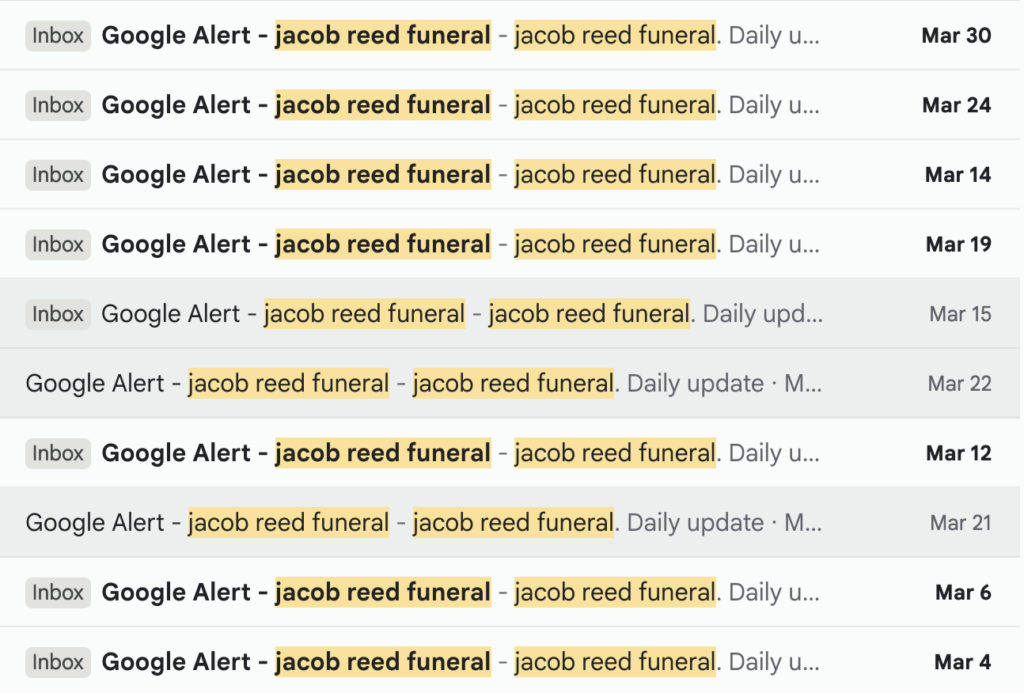
When I started making this podcast, I set up a Google alert: “Jacob” + “Reed” + “funeral.” Obituaries usually include a middle name, so searching those words separately would only surface Jacob Reeds without one. The result: a couple of times a week, an email appears in my inbox that reads:
So, basically, I have engineered a system where, while pursuing other Jacob Reeds, I get a regular reminder that I am going to die.
Usually I mark the alert and move on. But one week it really hit me.
“The Ohio State Patrol has identified the person who died in the head-on crash that happened on Friday night. Troopers said Jacob Reed, 25, from Scott Depot, was pronounced dead at the scene.”
An elderly man had driven the wrong way on SR 735. Young Jacob Reed was a passenger in the other car. He graduated from West Virginia University with a degree in industrial engineering. He was employed by Eaton Corporation within their leadership development program. He had an infectious smile and a sense of humor. He had a longtime girlfriend named Valerie, and their dog was named Chauncey — everyone called him the big guy.
Reading the list of his loved ones, I found myself thinking about what would fit in my own obituary’s word count.
I asked my producers to pull every Jacob Reed who’d passed away into a list.
There were 22 of them.
I read through them all, one after another.
Jacob Albert Reed, Ontario, Canada. Jacob Reed Dunsmore, Parker City, Indiana. A Honolulu police officer who died at 36 from pneumonia — his lung burst, causing liver and kidney failure. A 26-year-old from Jeffersonville. A woodworker from New Orleans who found joy in the simplest pleasures. A fifteen-year-old whose obituary described a kid who loved Green Day and The Simpsons.
“Defining someone by who they were at 15 is really heartbreaking. I’m imagining being a parent and being like — what do we say? He is a kid.”
And then: Jacob Edward Reed, born March 3rd, 1985. Same year as me. He passed at 29 after a battle with esophageal cancer. Football star at Shawnee High School. He and his identical twin brother Pierce helped bring home their first state championship in 2002.
“It’s heavy to read all these, just one after another after another.”
I’d already outlived the majority of Jacob Reeds on the list. There was something like survivor’s guilt in that. What was I doing with the time they never got? Making a podcast?
If you haven’t read an obituary with your own name on it, it’s hard to explain what it feels like. It’s like fan fiction of your own death, except it really happened. You know it’s not you. But seeing your name as the deceased feels eerily real.
Reading through them all, I kept thinking back to that college sketch.
“Smothered with a pillow. Choked on a rather large wishbone. Sawed in half at a local magic show.”
Unlike the sketch, there was nothing funny about this.
That’s when I realized: I’d already talked to someone who’d known a deceased Jacob Reed
In an earlier episode, while trying to track down a British gospel musician named Jake Reed, I’d called the studio where he recorded. The man who answered had told me Jake was no longer with us. I decided to reach back out.
Dan Wesley runs Twangmeister Studios in Grimsby, a small town in Lincolnshire, England. Jake Reed had turned up at his church already in his seventies — a retired policeman who’d recently found his faith and wanted to record his original songs. Country gospel. Not exactly a booming market in the UK in any era.
“There’s a large attitude this side of the pond that country’s really only for old people and Americans. If you’re making this kind of music in the UK, you have to accept you’ll never be a millionaire.”
None of that stopped Jake. He ended up recording an EP of four original songs with Dan.
{{EMBED: Jake Reed — “Let’s Sing For Jesus”}}
The biggest impact Jake had on Dan, though, had nothing to do with music. Dan was born with cataracts in both eyes. Surgery in the seventies left him with only about 15% vision in one eye, and had put the other out of commission entirely. His sons had both been successfully operated on years later — medicine had improved. But Dan had never considered fixing his remaining eye himself. Too risky. Anything goes wrong, he’d be completely blind.
During a recording session one Tuesday, Jake said: “Can I pray for your eye?”
The next day, Dan took his sons for a routine checkup. Their surgeon asked, almost as an aside, whether Dan would like him to look at his eye too. Normally Dan would have said no. But he’d watched this same surgeon work with his own kids. And the day before, Jake Reed had prayed for that eye.
“I don’t think this is a coincidence. And so I took that as a sign and said, yeah, let’s do it.”
He wasn’t miraculously healed — it was a skilled surgeon with better tools than existed thirty years prior. But it was because of Jake that Dan said yes.
“I could suddenly see so much better than I ever had in my life before, and the world became a brighter place. Jake had a profound effect on my life.”
After Jake passed, his son asked Dan to sing one of Jake’s original songs at the funeral — a song Jake had written himself, called Going Home.
{{EMBED: Jake Reed — “Going Home”}}
When I first heard about Twangmeister Jacob Reed, his background felt like the setup to a joke. British guy retires and starts making American gospel music. A few minutes with Dan later, that punchline had become a full person — someone who left a real mark on the people around him.
Thinking about Dan singing at Jake’s funeral made me think about my own funeral for the first time. I’d never really pictured it. I needed to understand what happens to a body — and who handles it. So I got in a car and drove to Fresno, to a place called the Reade Family Funeral Home — where I met Ryan Reade.
Ryan grew up in a funeral home. His parents ran one in Pasadena before moving. He has memories of learning to dress bodies and apply cosmetics when he was five. For his whole adult life, he wanted nothing to do with the industry — he did construction and almost became a police officer. But family businesses have a way of pulling you back in.
Since he’s always been a part of it, Ryan has seen everything. A pastor got knocked out. There was apparently supposed to be a drive-by at one service — Ryan had made his peace with jumping into the hole if shooting started. An unknown woman was crying on his dad. A guest started throwing up.
Ryan’s father Enrique got into the business by chance — a woman on the street offered him ten dollars to help dress a body, and he never really left. He eventually opened his own funeral home and became one of the best in the business at reconstruction: if someone came in with half their face gone from a car accident, Enrique could rebuild it with wax and cosmetics and ask the family if they wanted an open casket.
When Enrique passed in 2020, he was buried in pajamas — “I’m in a suit every day of my life, I wanna be comfortable” — inside a coffin he’d been using as a coffee table for thirty years.
Ryan walked me through the facility. The casket showroom worked like a car dealership — base models, color options, trim packages, corner pieces you could customize to show the afterlife how much the deceased liked golf or fishing or cats. In the back: a cremation retort running at 422 degrees, which Ryan explained was just warm-up temperature. Set point was 1,650.
“The smaller you are, the longer you take. The bigger you are, the faster you are. More fat, more fuel.”
Being Jewish, standing in front of a brick oven large enough for a human body, I could not stop my mind from going somewhere very dark. I’m going to spare you the full weight of that thought — and instead ask you to picture Ryan’s other project: converting his dad’s 1994 hearse into a hydraulic lowrider, to offer families from motorcycle clubs and car clubs for their loved ones’ funerals.
Next to the crematorium was a walk-in refrigerator — like the kind at a restaurant. On the whiteboard next to it: a list of names. Twenty-two of them.
“So all of these names on the wall are deceased people that are behind that door?”
“Yeah. That’s right.”
The Reade Family Funeral Home is one of the last family-owned funeral homes in California, and the only one that handles funerals for the almost half a million migrant workers in the Central Valley. When a farmworker dies and their family wants to bring them home to Mexico, Ryan drives to Sacramento for the paperwork, takes it to the Mexican consulate, and then drives to LAX to transport the body to the flight. The big corporate chains won’t do it. Ryan’s dad always did.
“My dad always said, ‘One day this is gonna be ours.’ Is he looking down? Does he know what’s going on? I hope so.”
After the funeral home, I wanted to understand death from the other side — what it actually feels like to be the person dying. I called Eileen, a hospice care worker. Over her 15-year career, Eileen has witnessed somewhere around 2,250 individual deaths.
What Eileen told me reframed things. We cling to life so hard that we often make dying a terrible experience — pushing fluids and interventions when the body already knows what to do. Her job is to let it do that.
“I always feel like it’s an honor to be with people as they’re passing.”
She told me about watching patients in their final hours call out to people no one else in the room could see — family members who had already died, reaching out from wherever they’d gone.
“When you’re born, you come out into the world and all these people greet you. I kind of think it’s the same way when you die.”
My skeptical brain started explaining this away — brain chemistry, the compounds released near death — but Eileen pivoted to a more immediate question: what were my end-of-life plans? Did anyone I loved know what I wanted?
I didn’t have an answer.
I went home and had the conversation with Heather.
Heather wants to be buried with all her jeans. Like a pharaoh, but with denim. She wants to be kept alive if there’s hope, but not indefinitely. She’s against standard burial on ecological grounds — though her main practical concern was grave robbers. I was against cremation, largely because I had recently discovered via Google that yes, your belly button does burn.
We went down a rabbit hole about tree pod burial — a process where cremated ashes are placed inside a biodegradable egg-shaped pod, buried as a seed in the earth, with a tree planted on top. It looked incredible. It was also, per Reddit, only available in Perth, Australia; the ashes are actually harmful to plant health due to their pH; and no cemetery in Perth actually offers the service.
“I was told by my daughters they will not allow me to do this because, quote, ‘That is how you get a haunted forest.'”
We landed on a green burial — body in the ground, no casket, tree on top. Together, if possible.
“Growing a tree together would be rad.”
Heather believes something happens to your energy after death — she can’t comprehend that it just dissipates. I think we go back into the soup. She asked if that was reincarnation. I said no — more like: we all came from the same thing and we return to it. We agreed on a five-year rule before either of us could remarry. She clarified she’d want me to find someone hotter and younger. I said age-appropriate. We did not reach consensus.
Before the Heather conversation, I’d also tried something more conventional. I told my therapist Seth what I’d been doing and asked him to make sense of it. He’s been my therapist for five years. He agreed to let me record a session.
He was measured about the Google funeral alerts — outside the norm, sure, but not necessarily problematic, depending on what I was actually getting from it. He started to wonder if some part of me was trying to gain mastery over death, to prepare for it by watching it happen to others.
Then a listener named Tom Hanks — not that Tom Hanks — sent me an email with a passage from a novel: “At your age, life is full of possibilities, but as the years pass, those possibilities vanish one by one, like doors closing in a hallway. One day you realize you’re too old to be a famous musician or change careers or have more children, and each of those closed doors represents a regret.”
That’s what was actually at the bottom of this. Not death exactly — but time. The fear that I’m running out of it before I’ve done what I was supposed to do with it.
“I really thought that at this point in my life, my creativity and my ideas would be the engine helping me pay for things. And I do have a real fear that I’m going to run out of time to do all the creative stuff I want to do. I guess death is the major way of running out of time.”
I told Seth I used to tell my producer Danny: if I die before this podcast is finished, you’ve got to finish it for me. Seth didn’t let that go.
“If I’m dead, I need this podcast finished. So why — after you die, when for you there may be nothingness — why does it matter that it gets out there? Legacy for who?”
I tried to explain it as altruism. He called bullshit.
“Anyone could have done this, Jacob. There’s a reason you’re doing it.”
He wasn’t knocking it. He was pointing out that exploring yourself publicly, because you believe your story and perspective matter and you have a need to tell it — that’s not selfishness. Altruism and self-interest can coexist. But the more uncomfortable thing was admitting which was which.
Just before our time was up, I asked the real question: Why can’t I let this go? Why do I care so much?
He told me we’d run out of time. This, apparently, is a known phenomenon in therapy: the doorknob confession. The breakthrough that arrives exactly when your hour is up.
“We’ll keep exploring you. Don’t worry. Therapy doesn’t end just because the podcast does.”
Seth’s question stayed with me. I went back to the spreadsheet. Back to Jacob Edward Reed — born six days from me, same year, died at 29.
I found an article about his identical twin brother Pierce, who had gone public with their story, speaking at churches and schools and sober living houses. I reached out. He was willing to talk.
What followed was one of the most extraordinary conversations I’ve had on this show.
Pierce and Jacob were high school heroes — state championship football, the kind of teenagers whose names get said with reverence for years afterward. Pierce got a college scholarship to play ball, but a shoulder injury ended his career. The surgery left him with Oxycontin. One day he made a decision he’s been living with ever since.
“I made the decision one day to introduce them to my brother, because they made me feel good. I wanted him to feel the same way.”
Jacob got hooked just as fast. They were working 16-hour days in restaurants. The drugs helped. Then came Adderall. Then cocaine. Then, when the money ran out:
“I wrote on a piece of paper in my car, ‘Gimme all of your Oxycontin, put ’em in a bag or I’ll shoot you.’ Went into CVS. Didn’t even wear a mask. Didn’t even have a weapon.”
Five robberies. Four for Jacob. They were arrested two days after Christmas, in their boxers, pulled from their parents’ basement in the middle of the night. They went through withdrawal in separate cells — Pierce’s first cellmate was in for murdering his pregnant girlfriend. Because they were identical twins, the prison separated them for security. Pierce could see Jacob’s cell window from his facility, just across the wall.
In 23-hour lockdowns, with nothing but time, they started reading the Bibles that an old high school girlfriend named Jenna had mailed them. Their minds started to change. Then their hearts.
Jacob turned out to be an extraordinary chef. He cooked restaurant-quality meals for the guards in exchange for fresh ingredients — shrimp, pasta, lobster tails. Prisoners transferred from his facility would see Pierce and freeze, thinking they’d seen a ghost.
“They’d be like, ‘Oh man, your brother’s the best. He helped me out with this.'”
Jacob had been managing a condition called Barrett’s esophagus since he was young. In prison, prescription medications would sometimes get raided or destroyed during cell checks. Months would pass between doses. By the time he got out and moved into a halfway house and began a relationship with a woman named Lauren, something had been quietly getting worse.
He collapsed. They found a tumor. Stage four esophageal cancer.
He was sent back to prison to receive chemotherapy — the wrong kind for his cancer. He went from 230 pounds to 140 in a month and a half. He was eventually granted early medical release, four months before the end of his sentence. It was the first time Pierce had seen him in six years. Before Jacob arrived, Pierce shaved his own head so Jacob wouldn’t feel weird about his.
“He wasn’t mad. He wasn’t upset. He was positive. He was himself.”
Jacob proposed to Lauren. They planned the wedding around Pierce’s halfway house schedule — he could only leave for work and church — and held the ceremony right down the street from the bakery where Pierce worked nights. Pierce was the best man. He gave his speech, slammed dinner, and went to work.
Two days before Jacob died, a tattoo artist named Little Dave came to the hospice and tattooed him.
Pierce said goodbye over FaceTime on his boss’s phone. The state permitted him to attend either the memorial service or the viewing at the funeral home — not both. He chose the funeral home.
“I was able to see him there for about an hour. And then I was taken back to the facility.”
“I came home at the end of that year to a whole different world. One that Jacob wasn’t in anymore.”
Seth asked me: why does it matter that people hear this even if you’re not around anymore?
Talking to Pierce, I think I finally understood.
We reduce people to a blurb because it’s easier. If you only read Jacob Reed’s obituary, he was a high school football star. If you only heard about him on the news, he was a drug addict and a thief. Neither tells the full story. He got married and tattooed in the last weeks of his life as if his whole future was ahead of him.
Twangmeister Jake Reed wasn’t just an oddball late-in-life gospel musician — he helped a man decide to let a surgeon give him his sight back. Enrique Reade started his career for ten dollars and spent decades helping farmworkers get home with dignity. Eileen watched her father die and spent fifteen years making sure no one has to face that moment alone.
The people we talked to in this episode didn’t tell us about their loved ones’ biggest achievements. They told us about the little things. The decisions they made every day in the way they lived their lives.
I’ve been preoccupied with death because I’m afraid I won’t leave enough behind. But these stories aren’t really about leaving something behind. They’re about how fully someone used the time they had.
Pierce named his first son after his brother. He’s eight now. He already knows the whole story.
“I feel like he’s more proud to be a Jacob Reed now that he knows the things my brother overcame.”
Pierce has a memorial tattoo across his chest — a passage from Second Corinthians: “Therefore we do not lose heart. Though outwardly we are wasting away, inwardly we are being renewed day by day.”
“He’ll always be a part of me. It’s something I probably won’t ever get over. But I kind of don’t want to get over it. It’s okay to be sad. It’s okay to feel pain. It makes you. That’s what makes you alive. That’s what makes you human.”
Jacob Reed and Me releases new episodes every Wednesday. Listen on Apple Podcasts, Spotify, YouTube, or wherever you get your podcasts. Support the show and get early episodes at Patreon.
This podcast was recorded in the Octavia Lab, a free DIY makerspace inside the Los Angeles Public Library’s downtown Central Library. Visit lapl.org/labs to learn more.
Got A Same Name Story?
Record a message below and we may use it on air. You can also call our same name line: 1-94-SAME-NAME